
Poco burst onto the scene with the F1 back in 2018 and since then, the company has had very selective launches through the years while also diversifying its portfolio across budget segments. The F series remains synonymous with offering a powerful processor at a relatively low price, and its the same formula applied to the latest Poco F5 5G. This is currently the only phone sold in India with a Qualcomm Snapdragon 7+ Gen 2 SoC, which shares a lot of its DNA with the flagship Snapdragon 8+ Gen 1. The F5 also checks many other important boxes as it comes with an optically stabilised primary camera, very fast charging, and even an IP rating.
Should the new Poco F5 5G be on the top of your list if you have a budget of around Rs. 30,000? We find out in this F5 5G price in India
The Poco F5 5G comes in two RAM variants, 8GB and 12GB, and both feature 256GB of storage. Prices are Rs. 29,999 and Rs. 33,999 for the respective variants. The pricing is not bad in my opinion, considering the collective set of features on offer. You also get a full kit of accessories in the box, including a 67W power adapter and a case.

The Poco F5 5G has a bright and vivid OLED display
The display on the Poco F5 5G is nice and vibrant. What's immediately noticeable are the evenly slim bezels on all four sides of the display. The screen itself is a 12-bit pOLED panel with a full-HD+ resolution, 120Hz adaptive refresh rate, and supports Dolby Vision and HDR10+ video playback. Poco claims it has a 1,000 nits peak brightness. The phone comes with a screen guard pre-applied but the display does have Corning Gorilla Glass 5 protection.
Poco F5 5G specifications and software
The Qualcomm Snapdragon 7+ Gen 2 is a power-efficient SoC built on the 4nm process. It uses the same CPU clusters as the Snapdragon 8+ Gen 1 SoC in the 1+3+4 configuration, only with slightly lower frequencies. There are some other differences as well such as a less powerful GPU, lower memory bandwidth, etc. The Poco F5 5G supports a total of 12 5G bands in India, along with Bluetooth 5.3 and dual-band Wi-Fi ac. Poco says it has used a vapour chamber cooling system consisting of 14 graphite sheets to better manage heat.
The Poco F5 5G runs MIUI 14 (14.0.3) which is based on Android 13. Poco has promised to deliver two years of Android updates and three years of security updates for the F5 5G. As usual, there are a tonne of preinstalled apps and shortcuts on the homescreen by default. Some of the native apps which cannot be uninstalled are also notorious for cluttering the notification shade with ads and unwanted alerts. Thankfully, some of the apps such as Music and Themes allow you to disable ads and recommendations, but this doesn't stop the alerts completely.
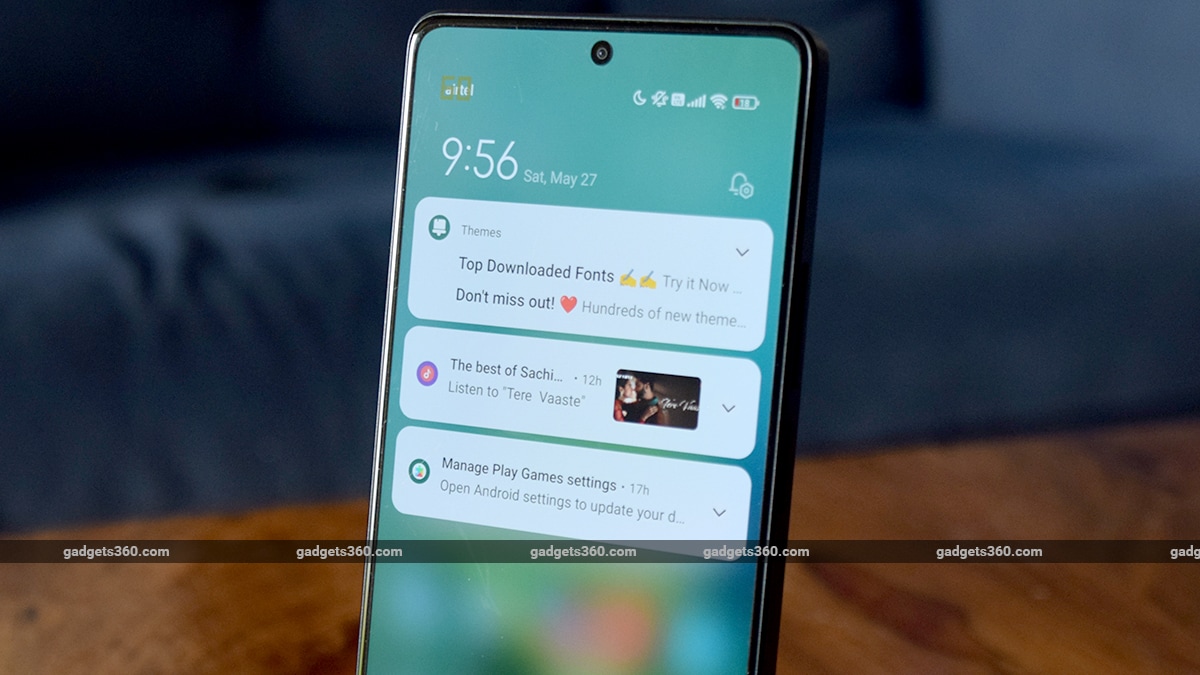
Spammy recommendations can't be stopped from some apps on the Poco F5 5G, despite disabling the toggles within the apps
Some of the useful bundled apps include Game Turbo which has a slick interface and allows you to tweak the system performance for games.
Poco F5 5G performance and battery life
This new SoC in the Poco F5 5G has some ridiculous amount of raw power. While we usually don't put too much stock into benchmark numbers, they can be a good indicator of the kind of real-world performance one can expect. In AnTuTu (v10), the Poco F5 5G managed 10,94,798 points and a score of 13,498 in PCMark (Work 2.0). These are impressive numbers and not too far behind Qualcomm's current flagship, the Snapdragon 8 Gen 2.
The 12GB variant of the Poco F5 5G that I've been testing hasn't skipped a beat yet in the past few weeks. System performance has been snappy, multi-tasking works like a charm, and apps are quick to load. Heat management has also been quite satisfactory so far as even when gaming, the phone only gets warm.
Titles such as Asphalt 9: Legends and Genshin Impact, both ran very well with solid framerates. Fast-paced shooters such as Call of Duty: Mobile ran very well on the ‘High' graphics and ‘Max' framerate setting. With the latter game, the display continued to run at 120Hz which made gameplay feel a lot more fluid, unlike most other games where it dropped to 60Hz.

The Poco F5 5G charges relatively quickly thanks to the bundled power adapter
HDR video playback looks good in apps such as Netflix which has many Dolby Vision TV shows and movies. The display produces punchy colours and has very good brightness levels for outdoor use during the day. The side-mounted fingerprint sensor works well and even face recognition is surprisingly quick in low light.
Battery life has been pretty great so far. The Poco F5 5G lasted for a good 17 hours, 34 minutes in our HD video loop test, which is above average. The real-world backup time was also pretty good, with the phone easily lasting more than a full day on average, even with heavy use. Charging is speedy with the bundled adapter as the F5 5G can charge up to 46 percent in 30 minutes and up to 93 percent in an hour.
Poco F5 5G cameras
The Poco F5 5G has three rear cameras; a 64-megapixel primary with optical stabilisation (OIS), 8-megapixel ultra-wide, and a 2-megapixel macro. The phone has a 16-megapixel selfie camera. Poco says it has added 2X “lossless” zoom mode, which uses a cropped portion of the sensor to capture a magnified image. There are also seven film camera filters if you want to add some retro effects to your photos.

You get three camera sensors on the back of the Poco F5 5G
The main camera captures decent landscape shots during the day. HDR is handled well, dynamic range is acceptable and colours are pleasing. The camera struggles a bit to resolve finer details in distant objects, for instance horizontal lines of a building can appear a bit jagged. These inconstancies are only really noticeable once you zoom into the image and go looking for them. There's no issue with close-up shots, which have good sharpness and well-saturated colours.

Poco F5 5G main camera sample (tap to see full size)

Poco F5 5G ultra-wide camera sample (tap to see full size)

Poco F5 5G main camera sample (tap to see full size)
Low-light images from the main camera have good exposure and details. I didn't notice much of a difference between regular and Night mode shots, which is a good thing. Images taken at 2X magnification during the day show no visible loss in details. The maximum zoom level is 10X and images are quite usable even at this level, provided you're shooting in daylight.
The ultra-wide camera expectedly doesn't capture as much details as the main one even under good lighting. Exposure can be a bit of a hit or miss too. In low light, this camera under-exposes the scene unless you use Night mode, which has a visible improvement. Macro photos from the macro camera are usually below average, even in good light.

Poco F5 5G low-light camera samples (tap to see full size)
The selfie camera on the Poco F5 5G is not great, but can capture passable selfies. It tends to struggle with backlit selfies, and the Portrait mode with this camera isn't very convincing. Low-light selfies have visible grain on facial features and details are a bit fuzzy.

Poco F5 5G front camera samples: Daylight (left) and low light (right)
The Poco F5 5G can capture videos up to 4K 30fps using the main camera, while the ultra-wide is limited to 1080p 30fps. Videos recorded at 4K look decent in the day but walking and shooting does introduce some jitter in the video, which is more pronounced in low light. The video quality from the ultra-wide camera is average as footage is generally under-exposed.
Verdict
The Poco F5 5G is an undeniable powerhouse at this price as it delivers raw performance that comes close to Qualcomm's flagship 8 Gen series SoCs. This, coupled with the good heat management makes the F5 5G an excellent option for anyone looking for a powerful smartphone for gaming. Other areas where the F5 5G excels are its display, good battery life, and slim design. I just wished it felt a bit more premium like its predecessor did. The selfie and ultra-wide cameras are also fairly average and could have been better.
If you want a more premium looking phone, the Nothing Phone 1 checks all the boxes at this price, and gets you wireless charging. The Samsung Galaxy A34 and Motorola Edge 40 are also worth considering if you need full-fledged waterproofing. If you are looking for good camera performance around this price, then the Redmi Note 12 Pro+ 5G makes a good alternative as it features familiar software, and comes with quicker charging and a better set of cameras.
Design & BuildLightweight for its size
Buttons in the usual places
Can feel flimsy
From the front, the F5 Pro is unremarkable, a black slab (white is also available) punctured only by the small hole of the front-facing camera, which is high enough up the screen not to get in the way of web pages and video content.
The plastic frame and glass sandwich construction helps to keep the phone fairly light for its size at 204g but feels flimsy, so a sturdy case will likely be top of the list for new owners – a soft silicone one comes in the box.
the back of the phone is toughened glass with kevlar detailing down the sides
Ian Evenden / Foundry
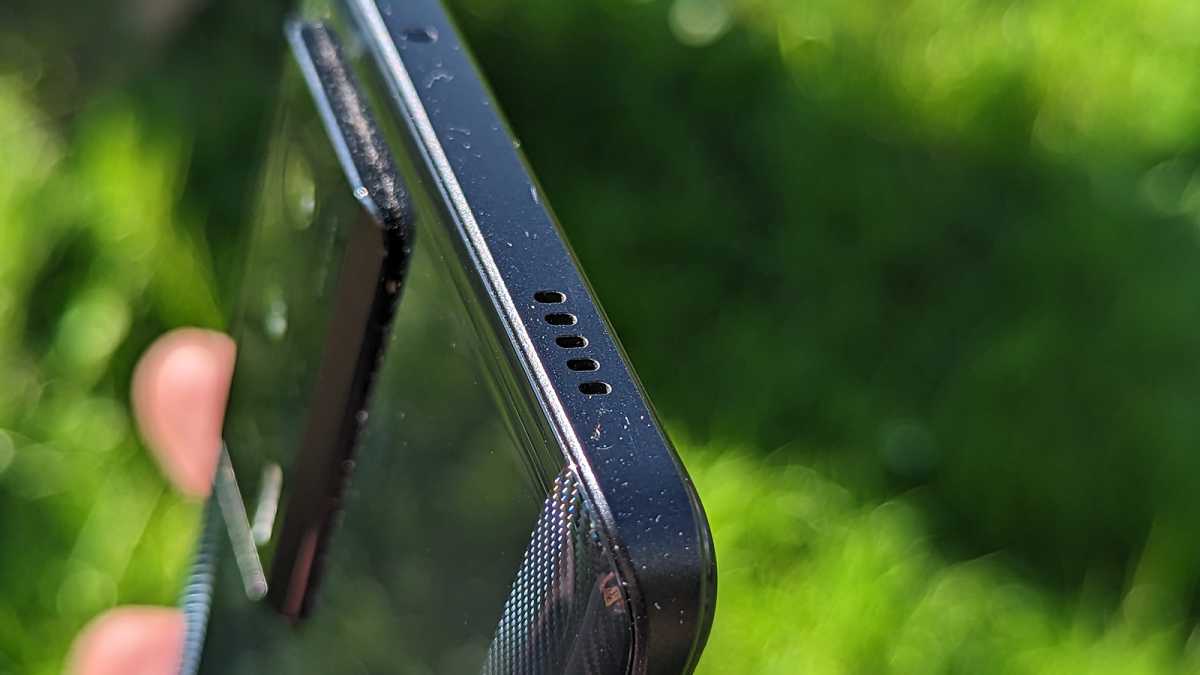
There’s Gorilla Glass 5 on the front, however, so no qualms about the solidity there, but the back of the phone is toughened glass with kevlar detailing down the sides and, handling the bare phone without a case, it can slide through the hand rather easily. It’s also shiny and attracts dust and fingermarks.
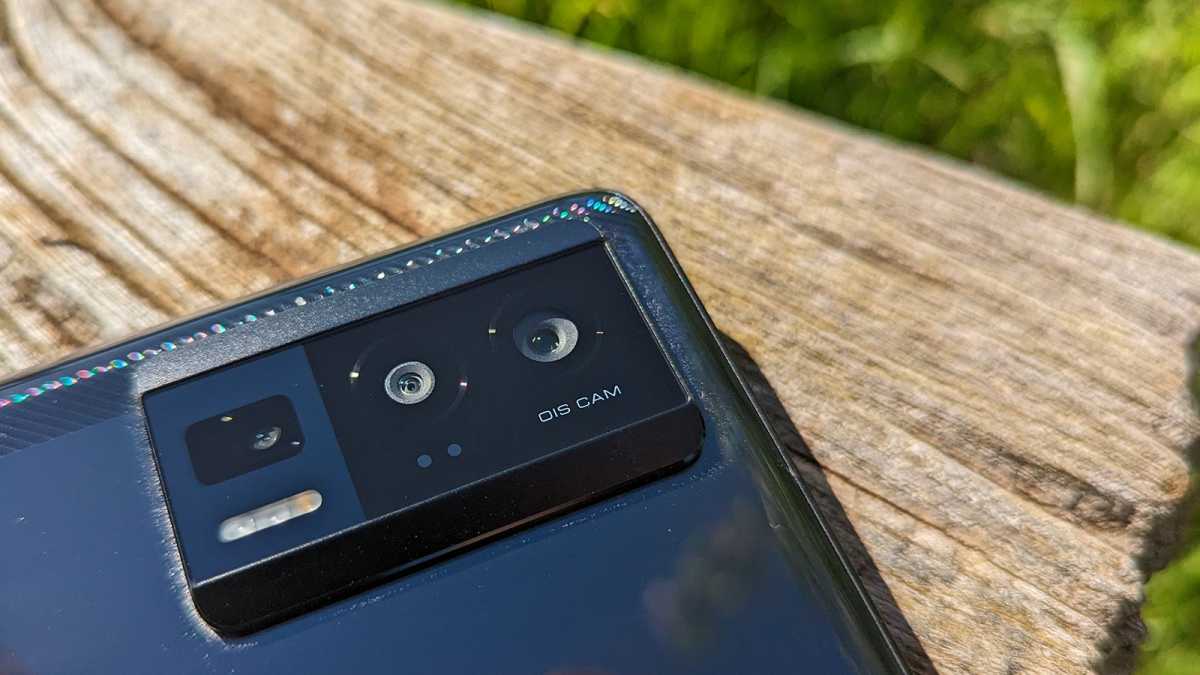
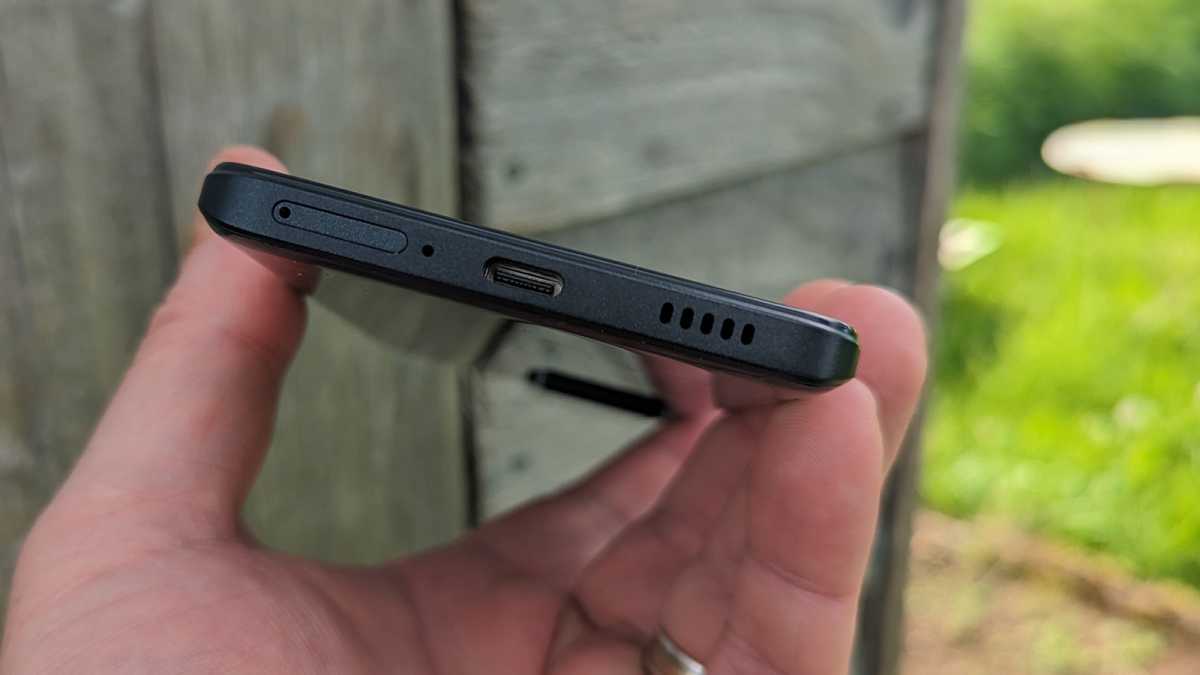
Everything else is exactly where you’d expect it to be, with a rectangular camera bulge angling up from the top left of the phone’s back, lock and volume buttons on the right, and a USB-C port on the base alongside the SIM tray. There’s no headphone socket, but there are two speakers, one each at the top and bottom of the phone.
Screen & SpeakersGood AMOLED display
Responsive fingerprint reader
The usual poor speakers
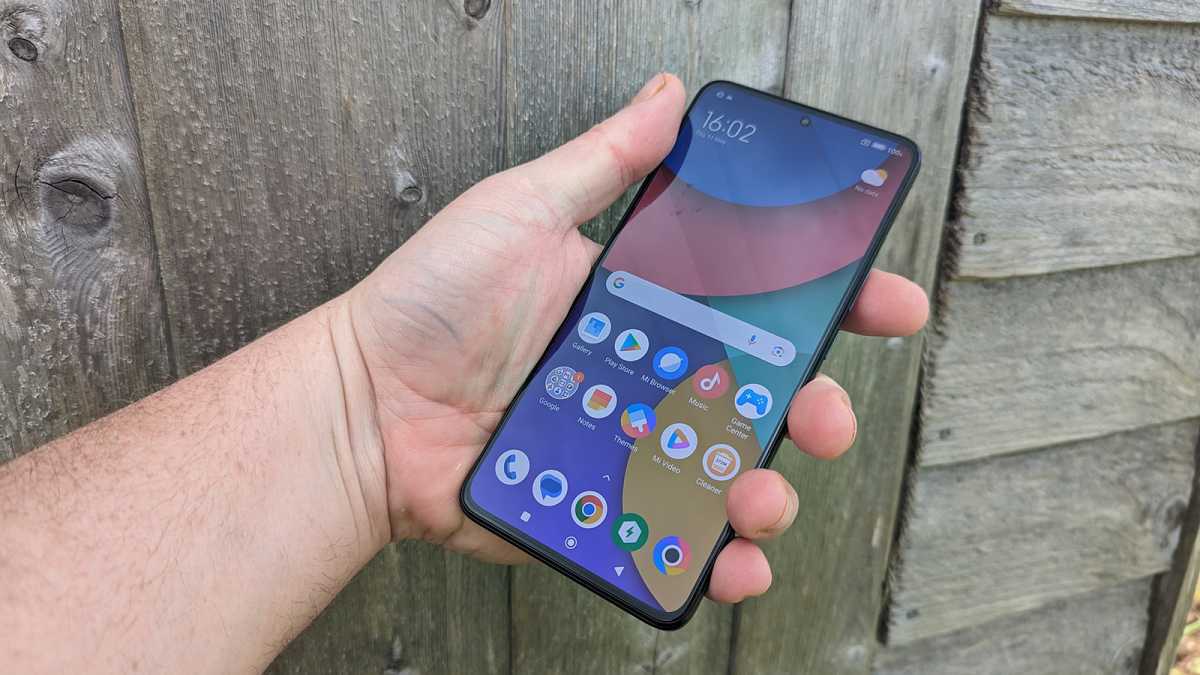
The speakers are small lines of five holes cut into the plastic of the phone body, but there are two and they’re intelligently placed, with one at each end of the phone so you can at least get some attempt at stereo sound when watching videos with the phone in landscape mode.
As is often the case with phone speakers, we’d recommend a pair of the best wireless headphones, or a Bluetooth speaker, instead of actually using them, but for speakerphone purposes, they’re generally fine, the low quality of the audio in such situations being well within their capabilities.
Ian Evenden / Foundry
The screen is a 6.7in AMOLED panel with a QHD+ resolution of 3200 x 1440 for a pixel density of 526ppi – almost exactly the same as that on the OnePlus 11. It can cope with HDR in the Dolby Vision and HDR 10+ flavours, with a peak HDR brightness of 1400 nits, though it more typically sits at 500 nits.
The max refresh rate of 120Hz means the animations and transitions of Android are completely smooth, something that adds to the feeling of responsiveness you get from the phone.
It’s a good screen to look at, and has rounded corners with a larger radius than I’ve seen on other phones, which contributes to a friendly look. You will find brighter models on the flagship phones of other manufacturers, but it’s got enough brightness output for a typical spring day in Britain, and use in bright sunlight shouldn’t be too much of a problem.
The fingerprint reader buried under the screen is also quick to react, recognising my thumb instantly and without having to resort to multiple tries.
Specs & PerformancePowerful chipset
Plenty of RAM and storage
Good for gaming
With a hot chipset like the Snapdragon 8+ Gen 1 inside, and plenty of RAM to back it up, you’d expect reasonable performance out of the Poco F5 Pro, and that’s exactly what you get.
Ian Evenden / Foundry
The Geekbench multi-core benchmark sees it level with Snapdragon 8+ Gen 1 phones such as the Xiaomi 12S Pro and Ultra and outpaces similarly priced phones. Sadly, the GFXBench tests wouldn’t work on the phone.
Only the Snapdragon 8 Gen 2 phones, such as the Samsung Galaxy S23 family, and (rarer) MediaTek Dimensity 9200 models offer greater performance on Android.
This naturally carries over to everyday handling, as apps and games spring open and, just as importantly, disappear quickly. Image editing, such as Google Photos’ changes to the sky in an image, are almost instant, while 3D graphics in XCOM: Enemy Within are smooth.
Poco is marketing the F5 Pro as a phone to play games on, and with its popular 6.7in screen size, it’ll fit in many game controllers. There’s also a Game Turbo mode that auto-detects games and boosts the phone’s speed when you’re playing one.
With a hot chipset like the Snapdragon 8+ Gen 1 inside, and plenty of RAM to back it up, you’d expect reasonable performance out of the Poco F5 Pro, and that’s exactly what you get
Cameras Good main camera
Others less impressive
Camera app full of features
With a large 64Mp unit with image stabilisation as its main camera, you’d expect excellent results from the Poco F5 Pro.
What you get, however, is a mixed bag. That main wide-angle camera – which is based on the Omnivision OV64B 1/2in sensor, has an f/1.8 aperture and bins its images down to 16.1Mp files – is fine but does its best work in good lighting conditions like any other phone camera, with low light-shots receiving a lot of visible processing. There’s a 2x digital zoom and the ability to shoot 8K video at 24fps if that’s your thing.
Ian Evenden / Foundry
The ultrawide camera is another matter. It’s an 8Mp f/2.2 model with a really wide 120° field of view but needs good light to produce a viable image and tends to smear details. The 2Mp macro camera is a bit of a head-scratcher too – it’s nice to have and is able to focus close enough to show you all the crumbs littering your computer keyboard, but the pretty low resolution images it produces aren’t much good for anything other than displaying on the phone’s screen.
You can use it like a magnifying glass to inspect beetles and rare coins you may come across in the course of your adventures, but that’s about its only use.
On the front is a 16Mp camera that’s good for video calls and selfies. It doesn’t do any pixel binning, so you get a larger file from the front than the ultrawide on the rear.



It can be used for video too, including the dual video mode that layers one shot over another for real time reaction shots and vlogging. All the standard Android video modes are present, such as time lapse and slow-mo, plus portrait and night modes for still images, and a Pro mode that gives you control over the camera settings.
There’s also an AI toggle at the top of the camera app that lets it intelligently switch between PASM modes depending on the scene you’re photographing.
Battery Life & ChargingFast 67W charging with included charger
30W wireless
All-day battery and beyond
With a 5160mAh battery on board – larger than that in the Pixel 7 Pro or Galaxy S23 Ultra – you’ll get decent battery life out of the Poco F5 Pro, and given the slender profile of the phone it’s a remarkable thing that Poco has managed to engineer space for all that power storage.
there’s also 30W wireless charging too – a rare find on a mid-range phone
Ian Evenden / Foundry
It can easily go all day, with the amount of time you spend before charging it the next depending on your usage. There’s an ultra battery saver mode to really eke out the usage to three days or more, but it lowers performance and restricts 5G connectivity.
Charging comes via a 67W wired charger which is included in the box and there’s also 30W wireless charging too – a rare find on a mid-range phone and not something you’ll find on the regular Poco F5.
Full-speed wired charging is extremely fast, with a 15-minute charge giving you 35% charge from zero and hits 50% after 30-minutes. The battery life benchmark in PCMark took a total of 12 hours and 32 minutes, which is a solid effort.
Software & AppsResponsive Android 13
MIUI has some problems
Lots of unnecessary apps
Android 13 is a great mobile operating system, but the skins phone manufacturers like to put over the top of it can vary in quality. Poco uses Xiaomi’s MIUI as you’d expect, and compared with the OS it’s layered over it can feel like a downgrade.
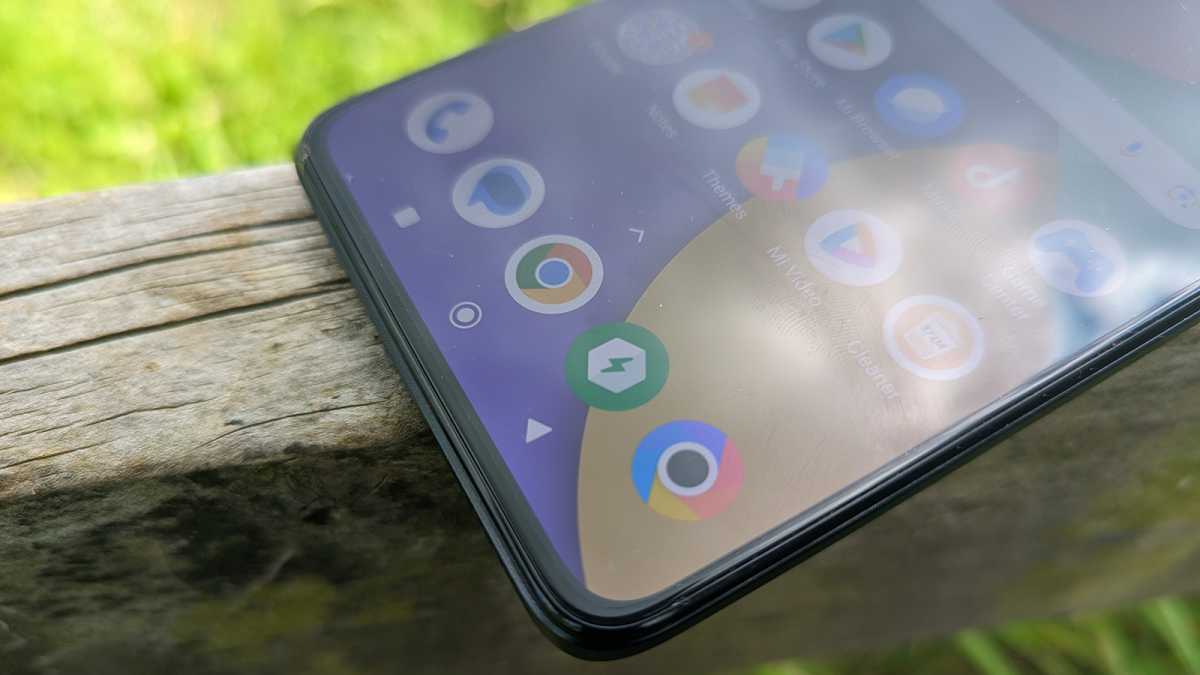
Firstly, by default it swaps the positions of the back and app-switcher buttons either side of the home button at the bottom of the screen, meaning it will take a little while for your muscle memory to adapt and stop swapping apps when you want to go to the previous web page.
It’s a UI that can be customised very easily with themes via a dedicated app. These themes vary from rather beautiful wildlife and nature photography to graphic patterns, cityscapes, animated flowers and butterflies, and even smiling shiba inus, but some of them have absolutely dire icons and the switch preventing a theme from changing home page icons didn’t appear to work for me.
Ian Evenden / Foundry
A lot of time might need to be spent customising the interface to your liking. One thing that’s also worth noting is that the company promises only two OS updates and three years of security updates.
Compare this with the three years of OS patches, and five years of security fixes, for the newly announced Google Pixel 7a and even more for the Samsung Galaxy A54, and it doesn’t look so good.
Alongside all this come the pre-installed apps you’ll probably never use and are just taking up space: games like Bubble Shooter, Jewels Blast and Dust Settle 3D, full of ads and IAPs. There’s the ubiquitous Booking.com app, plus Qeeq car rental and Asia-Pacific online travel agent Agoda.
Poco has its own app store, plus a Community and Video app – a half-hour spent Googling the names then uninstalling slims down the default app drawer nicely but is an unwanted chore.
Price & Availability
You can buy the Poco F5 Pro in its 12/256GB guise for £559, which is absurdly cheap – hundreds of pounds less than the OnePlus 11 Pro and Pixel 7 Pro.
This is the version most widely available online and is available from the official Mi store. Alternatively, you can import other models from AliExpress including the 512GB storage option.
Availability may become a problem, however, as it’s not currently available from a wide range of outlets. Even the Poco X5 Pro is a more common sight on the pages of online retailers than its F5 cousin but that might change over time including Amazon.
See more options in our best mid-range phones chart.
Verdict
There’s one thing that will immediately attract potential phone purchasers to the Poco F5 Pro – its price. For the kind of money, it’s a great bargain.
The specs are in-line with 2022 flagship models, and more than capable for the everyday uses we put our pocket supercomputers to. That you get long battery life, a nice main camera, and very fast charging tops off a great deal.
There are, of course, some caveats. I’m not too troubled by the plastic frame as most of the time this phone is going to live in a case, but the UI’s issues and short update life (a phone like this can easily remain useful beyond the three years of security patches that are being offered) mean the enticing hardware is let down by its software.
The 8MP ultra-wide sensor on the POCO F5 offers a 119-degree field-of-view, allowing for more comprehensive coverage. However, some distortion and softness can be noticed around the edges of the frame. The 2MP macro sensor, on the contrary, performs admirably well in capturing fine details in close up, particularly under good lighting conditions. In low light, the 64MP primary sensor is the sole flag-bearer among the rear camera setup, as both ultra-wide and macro sensors struggle quite a bit. The sensor manages to capture images with reasonable details and sharpness, even though the colour accuracy goes for a toss. The noise mode utility on the phone proves helpful in reducing noise levels and enhancing overall visibility in such scenes.

Talking about the front camera, which seems to have been downgraded to 16MP from the 20MP unit found on its predecessor, takes selfies with good facial detail. However, just like last year, the colours may appear slightly inaccurate in dimly lit environments. Additionally, the POCO F5 cameras come with a bunch of modes including portrait mode, which offers a natural-looking bokeh effect but the edge detection needs improvement, and the new film mode. The latter offers a bunch of filters to play around with. Overall, the POCO F5 has cameras that many casual users will like.
Performance and software
The POCO F5 is powered by the Snapdragon 7+ Gen2 chipset, which is the latest mid-range chipset from Qualcomm. Be that as it may, the chipset shares a lot of its traits with the company’s 2022 flagship Snapdragon 8 Gen 1 SoC, such as the nanometer process, cores, and GPU. The 8 Gen 1 still remains powerful in a few areas, but the new Snapdragon 7+ Gen2 chipset delivers exceptional performance that is hard to beat in its price range. This is reflected in the handset’s benchmark scores. The POCO F5 scores over 8,00,847 points on AnTuTu and 3,841 points on Geekbench’s multi-core test. The scores are significantly better than its competitor Nothing Phone 1 and on par with iQOO Neo 7, which rocks MediaTek Dimensity 8200 chipset. POCO F5 Geekbench (left) and AnTuTu (right) scores
In real-world usage, the POCO F5 handles everything effortlessly. It does not stutter or slow down, regardless of any task thrown at it. The gaming performance on the handset is commendable. It can smoothly run graphically-demanding games such as Call of Duty and Asphalt 9 with high graphics settings and frame rates. Even though the CPU Throttle test shows that the phone’s performance throttles under intense load, I personally did not encounter any issues while playing games on the device for half an hour or so. Additionally, the phone’s thermals always remained in check, thanks to the inclusion of a vapour chamber and graphite cooling technology. It is safe to say that the POCO F5 is one of the top choices for users seeking impressive performance within the mid-range smartphone segment.
 POCO F5 CPU Throttle (left) and PCMark Battery (right) tests
The handset is available in a couple of RAM options: 8GB and 12GB, which are further expandable using virtual RAM. On the storage front, the phone is equipped with 256GB, which isn’t user-expandable. Software-wise, the POCO F5 runs Android 13-based MIUI 14 out of the box. It is good to see the company offering the latest software out of the box. The handset has been promised to get two years of major OS updates and three years of security updates. It goes without saying that the phone has a few pre-installed apps, including games and an app store, and offers ads. However, spammy notifications are significantly reduced on this device. Besides this, I didn’t find any other difference between the POCO F5 and other smartphones running MIUI 14. Users have the freedom to personalise their experience through a multitude of customisation options, and they also have the option to uninstall the pre-loaded apps if desired.
Battery life and charging speeds

The POCO F5 houses a 5,000mAh battery and supports 67W fast charging. The latter takes approximately 45-50 minutes to fully charge the device from nothing. Once the battery level reaches 100 percent, it provides an all-day battery life even with heavy usage. I was hitting the bed with 20 percent juice still left in the tank after using the device through the day. The handset offers a screen-on-time of close to seven hours, and it performed impressively on the PCMark Battery test, with a score of 14 hours and 36 minutes.
Final verdict
The POCO F5 is a gaming-focused smartphone that has a lot to offer. Talking about the niggles, the handset lacks user-expandable storage, the software contains bloatware and ads, and its ultra-wide sensor is average at best. Additionally, some may dislike the phone’s glossy finish design.
If you prefer a more sophisticated design with a matte finish, the iQOO Neo 7 (review) could be a good choice for you. The smartphone, much like the POCO F5, is selling in India starting at Rs 29,999 and offers a superb performance with a lovely screen. What’s more, the Neo 7 supports 120W fast charging, which is nearly twice as fast as the POCO smartphone’s fast charging solution.
On the other hand, the POCO smartphone’s 12-bit display panel is a standout feature, a unique offering not found in any other smartphone in the segment. The POCO F5 also boasts a capable chipset, stereo speakers and solid battery life, which contribute to a better gaming and multimedia experience. If these aspects appeal to you, the POCO F5 will prove to be a worthy buy for the price.
Editor’s rating: 4 / 5
Reasons to buyThe POCO F5 performs exceptionally well in synthetic test apps as well as in the real world.
The handset has a stellar display that is fun to watch.
The smartphone offers an impressive battery life that can last you at least a day even with heavy usage.
The phone rocks one of the best stereo speakers that get sufficiently loud and produce clear and crisp audio.
Reasons not to buyThe software is riddled with bloatware and ads.
There is no microSD card slot to further expand the phone’s storage.
The POCO F5’s ultra-wide camera delivers average results with a lot of edge distortion.
Should the new Poco F5 5G be on the top of your list if you have a budget of around Rs. 30,000? We find out in this F5 5G price in India
The Poco F5 5G comes in two RAM variants, 8GB and 12GB, and both feature 256GB of storage. Prices are Rs. 29,999 and Rs. 33,999 for the respective variants. The pricing is not bad in my opinion, considering the collective set of features on offer. You also get a full kit of accessories in the box, including a 67W power adapter and a case.
The display on the Poco F5 5G is nice and vibrant. What's immediately noticeable are the evenly slim bezels on all four sides of the display. The screen itself is a 12-bit pOLED panel with a full-HD+ resolution, 120Hz adaptive refresh rate, and supports Dolby Vision and HDR10+ video playback. Poco claims it has a 1,000 nits peak brightness. The phone comes with a screen guard pre-applied but the display does have Corning Gorilla Glass 5 protection.
Poco F5 5G specifications and software
The Qualcomm Snapdragon 7+ Gen 2 is a power-efficient SoC built on the 4nm process. It uses the same CPU clusters as the Snapdragon 8+ Gen 1 SoC in the 1+3+4 configuration, only with slightly lower frequencies. There are some other differences as well such as a less powerful GPU, lower memory bandwidth, etc. The Poco F5 5G supports a total of 12 5G bands in India, along with Bluetooth 5.3 and dual-band Wi-Fi ac. Poco says it has used a vapour chamber cooling system consisting of 14 graphite sheets to better manage heat.
The Poco F5 5G runs MIUI 14 (14.0.3) which is based on Android 13. Poco has promised to deliver two years of Android updates and three years of security updates for the F5 5G. As usual, there are a tonne of preinstalled apps and shortcuts on the homescreen by default. Some of the native apps which cannot be uninstalled are also notorious for cluttering the notification shade with ads and unwanted alerts. Thankfully, some of the apps such as Music and Themes allow you to disable ads and recommendations, but this doesn't stop the alerts completely.
Spammy recommendations can't be stopped from some apps on the Poco F5 5G, despite disabling the toggles within the apps
Some of the useful bundled apps include Game Turbo which has a slick interface and allows you to tweak the system performance for games.
Poco F5 5G performance and battery life
This new SoC in the Poco F5 5G has some ridiculous amount of raw power. While we usually don't put too much stock into benchmark numbers, they can be a good indicator of the kind of real-world performance one can expect. In AnTuTu (v10), the Poco F5 5G managed 10,94,798 points and a score of 13,498 in PCMark (Work 2.0). These are impressive numbers and not too far behind Qualcomm's current flagship, the Snapdragon 8 Gen 2.
The 12GB variant of the Poco F5 5G that I've been testing hasn't skipped a beat yet in the past few weeks. System performance has been snappy, multi-tasking works like a charm, and apps are quick to load. Heat management has also been quite satisfactory so far as even when gaming, the phone only gets warm.
Titles such as Asphalt 9: Legends and Genshin Impact, both ran very well with solid framerates. Fast-paced shooters such as Call of Duty: Mobile ran very well on the ‘High' graphics and ‘Max' framerate setting. With the latter game, the display continued to run at 120Hz which made gameplay feel a lot more fluid, unlike most other games where it dropped to 60Hz.
The Poco F5 5G charges relatively quickly thanks to the bundled power adapter
HDR video playback looks good in apps such as Netflix which has many Dolby Vision TV shows and movies. The display produces punchy colours and has very good brightness levels for outdoor use during the day. The side-mounted fingerprint sensor works well and even face recognition is surprisingly quick in low light.
Battery life has been pretty great so far. The Poco F5 5G lasted for a good 17 hours, 34 minutes in our HD video loop test, which is above average. The real-world backup time was also pretty good, with the phone easily lasting more than a full day on average, even with heavy use. Charging is speedy with the bundled adapter as the F5 5G can charge up to 46 percent in 30 minutes and up to 93 percent in an hour.
Poco F5 5G cameras
The Poco F5 5G has three rear cameras; a 64-megapixel primary with optical stabilisation (OIS), 8-megapixel ultra-wide, and a 2-megapixel macro. The phone has a 16-megapixel selfie camera. Poco says it has added 2X “lossless” zoom mode, which uses a cropped portion of the sensor to capture a magnified image. There are also seven film camera filters if you want to add some retro effects to your photos.
You get three camera sensors on the back of the Poco F5 5G
The main camera captures decent landscape shots during the day. HDR is handled well, dynamic range is acceptable and colours are pleasing. The camera struggles a bit to resolve finer details in distant objects, for instance horizontal lines of a building can appear a bit jagged. These inconstancies are only really noticeable once you zoom into the image and go looking for them. There's no issue with close-up shots, which have good sharpness and well-saturated colours.

Poco F5 5G main camera sample (tap to see full size)

Poco F5 5G ultra-wide camera sample (tap to see full size)

Poco F5 5G main camera sample (tap to see full size)
Low-light images from the main camera have good exposure and details. I didn't notice much of a difference between regular and Night mode shots, which is a good thing. Images taken at 2X magnification during the day show no visible loss in details. The maximum zoom level is 10X and images are quite usable even at this level, provided you're shooting in daylight.
The ultra-wide camera expectedly doesn't capture as much details as the main one even under good lighting. Exposure can be a bit of a hit or miss too. In low light, this camera under-exposes the scene unless you use Night mode, which has a visible improvement. Macro photos from the macro camera are usually below average, even in good light.

Poco F5 5G low-light camera samples (tap to see full size)
The selfie camera on the Poco F5 5G is not great, but can capture passable selfies. It tends to struggle with backlit selfies, and the Portrait mode with this camera isn't very convincing. Low-light selfies have visible grain on facial features and details are a bit fuzzy.
Poco F5 5G front camera samples: Daylight (left) and low light (right)
The Poco F5 5G can capture videos up to 4K 30fps using the main camera, while the ultra-wide is limited to 1080p 30fps. Videos recorded at 4K look decent in the day but walking and shooting does introduce some jitter in the video, which is more pronounced in low light. The video quality from the ultra-wide camera is average as footage is generally under-exposed.
Verdict
The Poco F5 5G is an undeniable powerhouse at this price as it delivers raw performance that comes close to Qualcomm's flagship 8 Gen series SoCs. This, coupled with the good heat management makes the F5 5G an excellent option for anyone looking for a powerful smartphone for gaming. Other areas where the F5 5G excels are its display, good battery life, and slim design. I just wished it felt a bit more premium like its predecessor did. The selfie and ultra-wide cameras are also fairly average and could have been better.
If you want a more premium looking phone, the Nothing Phone 1 checks all the boxes at this price, and gets you wireless charging. The Samsung Galaxy A34 and Motorola Edge 40 are also worth considering if you need full-fledged waterproofing. If you are looking for good camera performance around this price, then the Redmi Note 12 Pro+ 5G makes a good alternative as it features familiar software, and comes with quicker charging and a better set of cameras.
Design & BuildLightweight for its size
Buttons in the usual places
Can feel flimsy
From the front, the F5 Pro is unremarkable, a black slab (white is also available) punctured only by the small hole of the front-facing camera, which is high enough up the screen not to get in the way of web pages and video content.
The plastic frame and glass sandwich construction helps to keep the phone fairly light for its size at 204g but feels flimsy, so a sturdy case will likely be top of the list for new owners – a soft silicone one comes in the box.
the back of the phone is toughened glass with kevlar detailing down the sides
Ian Evenden / Foundry
There’s Gorilla Glass 5 on the front, however, so no qualms about the solidity there, but the back of the phone is toughened glass with kevlar detailing down the sides and, handling the bare phone without a case, it can slide through the hand rather easily. It’s also shiny and attracts dust and fingermarks.
Everything else is exactly where you’d expect it to be, with a rectangular camera bulge angling up from the top left of the phone’s back, lock and volume buttons on the right, and a USB-C port on the base alongside the SIM tray. There’s no headphone socket, but there are two speakers, one each at the top and bottom of the phone.
Screen & SpeakersGood AMOLED display
Responsive fingerprint reader
The usual poor speakers
The speakers are small lines of five holes cut into the plastic of the phone body, but there are two and they’re intelligently placed, with one at each end of the phone so you can at least get some attempt at stereo sound when watching videos with the phone in landscape mode.
As is often the case with phone speakers, we’d recommend a pair of the best wireless headphones, or a Bluetooth speaker, instead of actually using them, but for speakerphone purposes, they’re generally fine, the low quality of the audio in such situations being well within their capabilities.
Ian Evenden / Foundry
The screen is a 6.7in AMOLED panel with a QHD+ resolution of 3200 x 1440 for a pixel density of 526ppi – almost exactly the same as that on the OnePlus 11. It can cope with HDR in the Dolby Vision and HDR 10+ flavours, with a peak HDR brightness of 1400 nits, though it more typically sits at 500 nits.
The max refresh rate of 120Hz means the animations and transitions of Android are completely smooth, something that adds to the feeling of responsiveness you get from the phone.
It’s a good screen to look at, and has rounded corners with a larger radius than I’ve seen on other phones, which contributes to a friendly look. You will find brighter models on the flagship phones of other manufacturers, but it’s got enough brightness output for a typical spring day in Britain, and use in bright sunlight shouldn’t be too much of a problem.
The fingerprint reader buried under the screen is also quick to react, recognising my thumb instantly and without having to resort to multiple tries.
Specs & PerformancePowerful chipset
Plenty of RAM and storage
Good for gaming
With a hot chipset like the Snapdragon 8+ Gen 1 inside, and plenty of RAM to back it up, you’d expect reasonable performance out of the Poco F5 Pro, and that’s exactly what you get.
Ian Evenden / Foundry
The Geekbench multi-core benchmark sees it level with Snapdragon 8+ Gen 1 phones such as the Xiaomi 12S Pro and Ultra and outpaces similarly priced phones. Sadly, the GFXBench tests wouldn’t work on the phone.
Only the Snapdragon 8 Gen 2 phones, such as the Samsung Galaxy S23 family, and (rarer) MediaTek Dimensity 9200 models offer greater performance on Android.
This naturally carries over to everyday handling, as apps and games spring open and, just as importantly, disappear quickly. Image editing, such as Google Photos’ changes to the sky in an image, are almost instant, while 3D graphics in XCOM: Enemy Within are smooth.
Poco is marketing the F5 Pro as a phone to play games on, and with its popular 6.7in screen size, it’ll fit in many game controllers. There’s also a Game Turbo mode that auto-detects games and boosts the phone’s speed when you’re playing one.
With a hot chipset like the Snapdragon 8+ Gen 1 inside, and plenty of RAM to back it up, you’d expect reasonable performance out of the Poco F5 Pro, and that’s exactly what you get
Cameras Good main camera
Others less impressive
Camera app full of features
With a large 64Mp unit with image stabilisation as its main camera, you’d expect excellent results from the Poco F5 Pro.
What you get, however, is a mixed bag. That main wide-angle camera – which is based on the Omnivision OV64B 1/2in sensor, has an f/1.8 aperture and bins its images down to 16.1Mp files – is fine but does its best work in good lighting conditions like any other phone camera, with low light-shots receiving a lot of visible processing. There’s a 2x digital zoom and the ability to shoot 8K video at 24fps if that’s your thing.
Ian Evenden / Foundry
The ultrawide camera is another matter. It’s an 8Mp f/2.2 model with a really wide 120° field of view but needs good light to produce a viable image and tends to smear details. The 2Mp macro camera is a bit of a head-scratcher too – it’s nice to have and is able to focus close enough to show you all the crumbs littering your computer keyboard, but the pretty low resolution images it produces aren’t much good for anything other than displaying on the phone’s screen.
You can use it like a magnifying glass to inspect beetles and rare coins you may come across in the course of your adventures, but that’s about its only use.
On the front is a 16Mp camera that’s good for video calls and selfies. It doesn’t do any pixel binning, so you get a larger file from the front than the ultrawide on the rear.
It can be used for video too, including the dual video mode that layers one shot over another for real time reaction shots and vlogging. All the standard Android video modes are present, such as time lapse and slow-mo, plus portrait and night modes for still images, and a Pro mode that gives you control over the camera settings.
There’s also an AI toggle at the top of the camera app that lets it intelligently switch between PASM modes depending on the scene you’re photographing.
Battery Life & ChargingFast 67W charging with included charger
30W wireless
All-day battery and beyond
With a 5160mAh battery on board – larger than that in the Pixel 7 Pro or Galaxy S23 Ultra – you’ll get decent battery life out of the Poco F5 Pro, and given the slender profile of the phone it’s a remarkable thing that Poco has managed to engineer space for all that power storage.
there’s also 30W wireless charging too – a rare find on a mid-range phone
Ian Evenden / Foundry
It can easily go all day, with the amount of time you spend before charging it the next depending on your usage. There’s an ultra battery saver mode to really eke out the usage to three days or more, but it lowers performance and restricts 5G connectivity.
Charging comes via a 67W wired charger which is included in the box and there’s also 30W wireless charging too – a rare find on a mid-range phone and not something you’ll find on the regular Poco F5.
Full-speed wired charging is extremely fast, with a 15-minute charge giving you 35% charge from zero and hits 50% after 30-minutes. The battery life benchmark in PCMark took a total of 12 hours and 32 minutes, which is a solid effort.
Software & AppsResponsive Android 13
MIUI has some problems
Lots of unnecessary apps
Android 13 is a great mobile operating system, but the skins phone manufacturers like to put over the top of it can vary in quality. Poco uses Xiaomi’s MIUI as you’d expect, and compared with the OS it’s layered over it can feel like a downgrade.
Firstly, by default it swaps the positions of the back and app-switcher buttons either side of the home button at the bottom of the screen, meaning it will take a little while for your muscle memory to adapt and stop swapping apps when you want to go to the previous web page.
It’s a UI that can be customised very easily with themes via a dedicated app. These themes vary from rather beautiful wildlife and nature photography to graphic patterns, cityscapes, animated flowers and butterflies, and even smiling shiba inus, but some of them have absolutely dire icons and the switch preventing a theme from changing home page icons didn’t appear to work for me.
Ian Evenden / Foundry
A lot of time might need to be spent customising the interface to your liking. One thing that’s also worth noting is that the company promises only two OS updates and three years of security updates.
Compare this with the three years of OS patches, and five years of security fixes, for the newly announced Google Pixel 7a and even more for the Samsung Galaxy A54, and it doesn’t look so good.
Alongside all this come the pre-installed apps you’ll probably never use and are just taking up space: games like Bubble Shooter, Jewels Blast and Dust Settle 3D, full of ads and IAPs. There’s the ubiquitous Booking.com app, plus Qeeq car rental and Asia-Pacific online travel agent Agoda.
Poco has its own app store, plus a Community and Video app – a half-hour spent Googling the names then uninstalling slims down the default app drawer nicely but is an unwanted chore.
Price & Availability
You can buy the Poco F5 Pro in its 12/256GB guise for £559, which is absurdly cheap – hundreds of pounds less than the OnePlus 11 Pro and Pixel 7 Pro.
This is the version most widely available online and is available from the official Mi store. Alternatively, you can import other models from AliExpress including the 512GB storage option.
Availability may become a problem, however, as it’s not currently available from a wide range of outlets. Even the Poco X5 Pro is a more common sight on the pages of online retailers than its F5 cousin but that might change over time including Amazon.
See more options in our best mid-range phones chart.
Verdict
There’s one thing that will immediately attract potential phone purchasers to the Poco F5 Pro – its price. For the kind of money, it’s a great bargain.
The specs are in-line with 2022 flagship models, and more than capable for the everyday uses we put our pocket supercomputers to. That you get long battery life, a nice main camera, and very fast charging tops off a great deal.
There are, of course, some caveats. I’m not too troubled by the plastic frame as most of the time this phone is going to live in a case, but the UI’s issues and short update life (a phone like this can easily remain useful beyond the three years of security patches that are being offered) mean the enticing hardware is let down by its software.
The 8MP ultra-wide sensor on the POCO F5 offers a 119-degree field-of-view, allowing for more comprehensive coverage. However, some distortion and softness can be noticed around the edges of the frame. The 2MP macro sensor, on the contrary, performs admirably well in capturing fine details in close up, particularly under good lighting conditions. In low light, the 64MP primary sensor is the sole flag-bearer among the rear camera setup, as both ultra-wide and macro sensors struggle quite a bit. The sensor manages to capture images with reasonable details and sharpness, even though the colour accuracy goes for a toss. The noise mode utility on the phone proves helpful in reducing noise levels and enhancing overall visibility in such scenes.
Talking about the front camera, which seems to have been downgraded to 16MP from the 20MP unit found on its predecessor, takes selfies with good facial detail. However, just like last year, the colours may appear slightly inaccurate in dimly lit environments. Additionally, the POCO F5 cameras come with a bunch of modes including portrait mode, which offers a natural-looking bokeh effect but the edge detection needs improvement, and the new film mode. The latter offers a bunch of filters to play around with. Overall, the POCO F5 has cameras that many casual users will like.
Performance and software
The POCO F5 is powered by the Snapdragon 7+ Gen2 chipset, which is the latest mid-range chipset from Qualcomm. Be that as it may, the chipset shares a lot of its traits with the company’s 2022 flagship Snapdragon 8 Gen 1 SoC, such as the nanometer process, cores, and GPU. The 8 Gen 1 still remains powerful in a few areas, but the new Snapdragon 7+ Gen2 chipset delivers exceptional performance that is hard to beat in its price range. This is reflected in the handset’s benchmark scores. The POCO F5 scores over 8,00,847 points on AnTuTu and 3,841 points on Geekbench’s multi-core test. The scores are significantly better than its competitor Nothing Phone 1 and on par with iQOO Neo 7, which rocks MediaTek Dimensity 8200 chipset.
POCO F5 Geekbench (left) and AnTuTu (right) scoresIn real-world usage, the POCO F5 handles everything effortlessly. It does not stutter or slow down, regardless of any task thrown at it. The gaming performance on the handset is commendable. It can smoothly run graphically-demanding games such as Call of Duty and Asphalt 9 with high graphics settings and frame rates. Even though the CPU Throttle test shows that the phone’s performance throttles under intense load, I personally did not encounter any issues while playing games on the device for half an hour or so. Additionally, the phone’s thermals always remained in check, thanks to the inclusion of a vapour chamber and graphite cooling technology. It is safe to say that the POCO F5 is one of the top choices for users seeking impressive performance within the mid-range smartphone segment.
POCO F5 CPU Throttle (left) and PCMark Battery (right) testsThe handset is available in a couple of RAM options: 8GB and 12GB, which are further expandable using virtual RAM. On the storage front, the phone is equipped with 256GB, which isn’t user-expandable. Software-wise, the POCO F5 runs Android 13-based MIUI 14 out of the box. It is good to see the company offering the latest software out of the box. The handset has been promised to get two years of major OS updates and three years of security updates. It goes without saying that the phone has a few pre-installed apps, including games and an app store, and offers ads. However, spammy notifications are significantly reduced on this device. Besides this, I didn’t find any other difference between the POCO F5 and other smartphones running MIUI 14. Users have the freedom to personalise their experience through a multitude of customisation options, and they also have the option to uninstall the pre-loaded apps if desired.
Battery life and charging speeds
The POCO F5 houses a 5,000mAh battery and supports 67W fast charging. The latter takes approximately 45-50 minutes to fully charge the device from nothing. Once the battery level reaches 100 percent, it provides an all-day battery life even with heavy usage. I was hitting the bed with 20 percent juice still left in the tank after using the device through the day. The handset offers a screen-on-time of close to seven hours, and it performed impressively on the PCMark Battery test, with a score of 14 hours and 36 minutes.
Final verdict
The POCO F5 is a gaming-focused smartphone that has a lot to offer. Talking about the niggles, the handset lacks user-expandable storage, the software contains bloatware and ads, and its ultra-wide sensor is average at best. Additionally, some may dislike the phone’s glossy finish design.
If you prefer a more sophisticated design with a matte finish, the iQOO Neo 7 (review) could be a good choice for you. The smartphone, much like the POCO F5, is selling in India starting at Rs 29,999 and offers a superb performance with a lovely screen. What’s more, the Neo 7 supports 120W fast charging, which is nearly twice as fast as the POCO smartphone’s fast charging solution.
On the other hand, the POCO smartphone’s 12-bit display panel is a standout feature, a unique offering not found in any other smartphone in the segment. The POCO F5 also boasts a capable chipset, stereo speakers and solid battery life, which contribute to a better gaming and multimedia experience. If these aspects appeal to you, the POCO F5 will prove to be a worthy buy for the price.
Editor’s rating: 4 / 5
Reasons to buyThe POCO F5 performs exceptionally well in synthetic test apps as well as in the real world.
The handset has a stellar display that is fun to watch.
The smartphone offers an impressive battery life that can last you at least a day even with heavy usage.
The phone rocks one of the best stereo speakers that get sufficiently loud and produce clear and crisp audio.
Reasons not to buyThe software is riddled with bloatware and ads.
There is no microSD card slot to further expand the phone’s storage.
The POCO F5’s ultra-wide camera delivers average results with a lot of edge distortion.
Tags
ANDROID