
Vivo T-series has always been known for its top-of-the-line specifications and aggressive price points. The company has now refreshed its popular T series with the launch of Vivo T3 Pro 5G, which promises to bring the same philosophy to the mid-range segment. The latest smartphone from the company comes loaded with a premium design language and brings features like Snapdragon 7 Gen 3 SoC, 50-megapixel dual rear cameras, 5,500mAh battery, and more. I spent some time with the latest T3 Pro smartphone, and here's what you need to know.

To start with the design, the Vivo T3 Pro 5G looks eerily similar to the recently launched iQOO Z9s Pro. The Vivo T3 Pro is available in two colour options: Sandstone Orange and Emerald Green. The Orange option comes with a vegan leather finish at the rear panel, while the Green option offers a glass back. I got the Sandstone Orange colour for the review, and it sure looks premium and sleek with just 7.49mm thickness.

The Vivo T3 Pro is available in Standstone Orange and Emerald Green colour options.
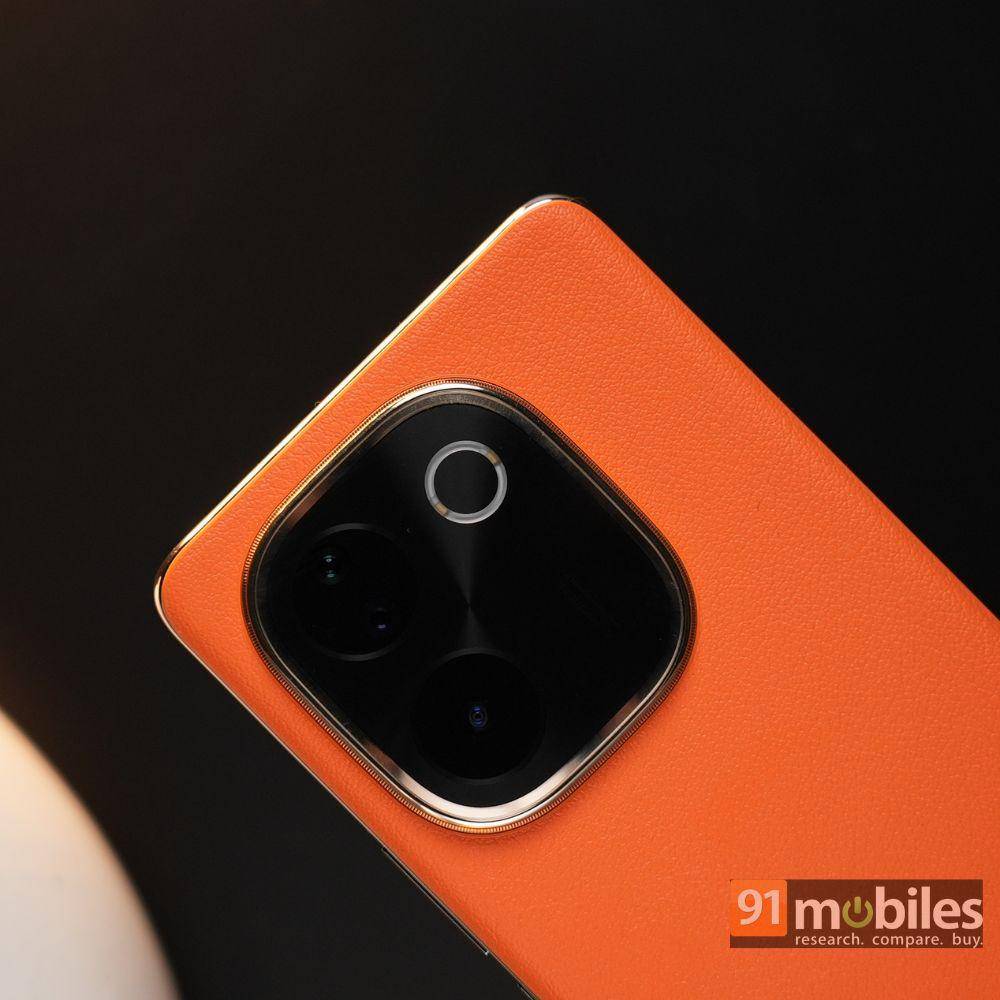
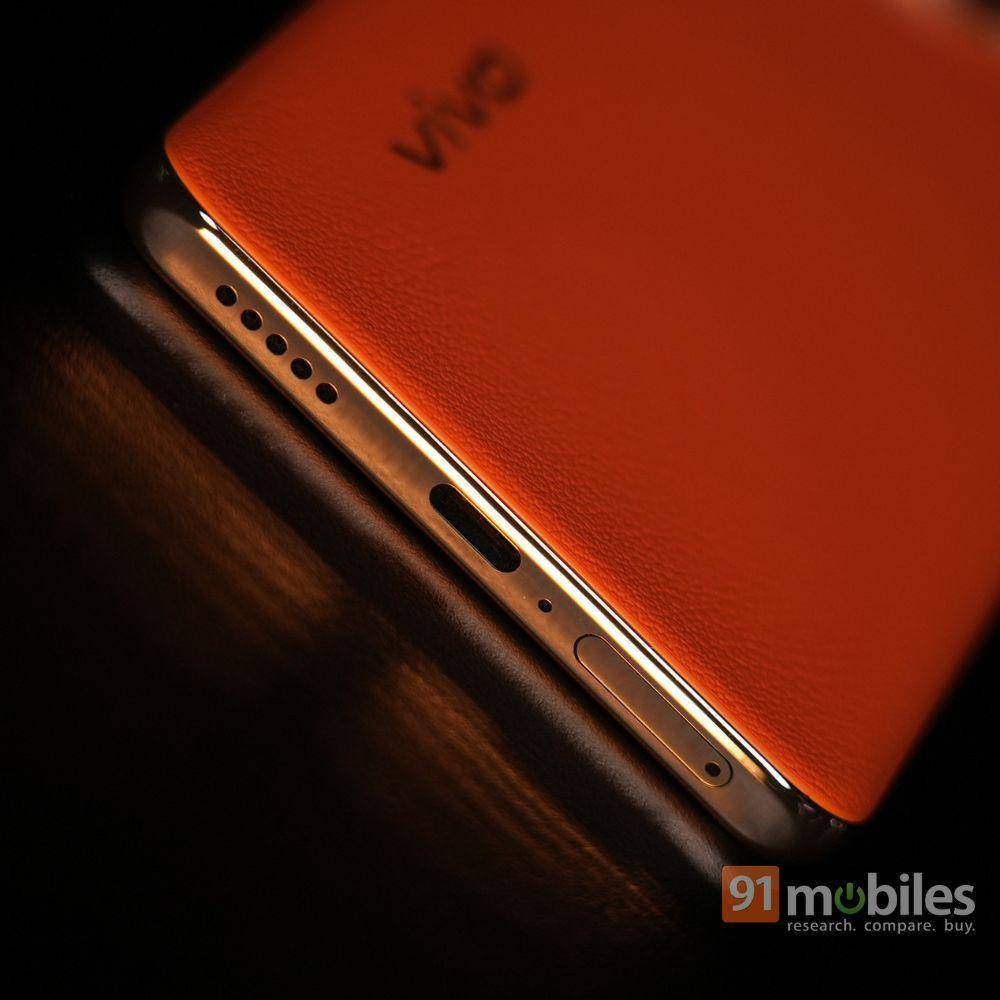
The rear panel offers a vegan leather finish that looks smooth and comfortable to hold. It also features a big camera module with two camera sensors and an LED light. The right side of the device features volume controls and a power on/off button. You will find a hybrid SIM tray, a USB Type-C port, and a speaker grille at the base.
Coming to the display, the Vivo T3 Pro offers a 6.77-inch Full HD+ curved AMOLED display. The device comes loaded with a 120Hz screen refresh rate and up to 4,500nits of peak brightness, making it one of the brightest displays in this price segment. The screen looks vibrant and smooth during the initial testing period, and you will get to know more in the in-depth review.

The handset features a 6.77-inch curved AMOLED display with 4,500nits of peak brightness.
Like the iQOO Z9s Pro, the Vivo T3 Pro is powered by the Qualcomm Snapdragon 7 Gen 3 processor paired with an Adreno 720 GPU. The chipset is capable of handling most of the tasks you run at it while still delivering an efficient battery life. The review unit I got has 8GB of RAM and 256GB of internal storage. You also have the option to expand the storage up to 1TB via a microSD card slot.
For optics, the Vivo T3 Pro employs a dual-camera setup on the rear panel. The phone features a 50-megapixel Sony IMX882 sensor with OIS support and f/1.79 aperture. It also features an 8-megapixel ultra-wide-angle lens with f/2.2 aperture.

The Vivo T3 Pro features a 50-megapixel Sony IMX882 sensor and an 8-megapixel ultra-wide camera on the rear.
The device packs a 16-megapixel shooter for selfies and video calling. Vivo is heavily banking on the camera capabilities of the Vivo T3 Pro. During the initial testing period, I found out that photos came to be sharp with vibrant colours. The portraits also came out to be clean in daylight conditions. However, I am yet to test out the full capabilities of the Vivo T3 Pro under different lighting conditions.
Lastly, the Vivo T3 Pro also features a 5,500mAh battery and supports 80W fast charging support. The handset also features an in-display fingerprint sensor along with stereo speakers. In terms of connectivity, you get 5G, Wi-Fi 6, Bluetooth 5.4, GPS, and more.

The smartphone packs a 5,500mAh battery with 80W fast charging support.
That said, the Vivo T3 Pro 5G is an interesting option at this price point. However, one of the biggest competitors for this smartphone will be its sibling. Yes, I am talking about the iQOO Z9s Pro, which also offers identical features and specifications. So, the question here is whether you can go for this device or choose the iQOO one. You will shortly get the answer to this question in our upcoming in-depth review. So, stay tuned with us.
Vivo’s new T3 series is all about performance, covering various price ranges from under Rs 15,000 to under Rs 35,000. The Vivo T3x and Vivo T3 were released earlier than the Vivo T3 Pro and Vivo T3 Ultra, and they lead their respective segments in terms of performance. The Vivo T3 Ultra is no slouch either, as it is one of the top performers under Rs 35,000. That brings us to the middle child, the Vivo T3 Pro. On paper, the Vivo T3 Pro certainly packs a punch with its Snapdragon 7 Gen 3 chipset, promising impressive power under Rs 25,000. In this review, I’ll walk you through what day-to-day life with the Vivo T3 Pro looks like.
Verdict
The Vivo T3 Pro offers a bright, vibrant display, versatile cameras, long battery life, and fast charging speeds. It performs well in gaming and everyday tasks, making it a solid choice for most users. While the UI of the device feels a bit bloated and the selfie camera could use some improvement, it delivers strong overall performance.
The Vivo T3 Pro has a chic look, especially the Sandstone Orange variant I got to try. The bright orange hue and vegan leather finish give it a bold vibe, with a large, gold-rimmed camera island that really stands out. The gold-plated sides and Vivo branding add to the overall design harmony. I’m not a huge fan of the colour way, but my friends seemed to love it, so it really comes down to personal taste.
The phone feels incredibly light and comfortable in hand, thanks to the curved edges. At the bottom, you’ve got the Type-C port, speaker grille, and SIM tray, while the volume rockers and power button are placed on the right edge as usual. With an IP64 rating, it’s also got some protection against dust and water splashes, offering a bit more durability.
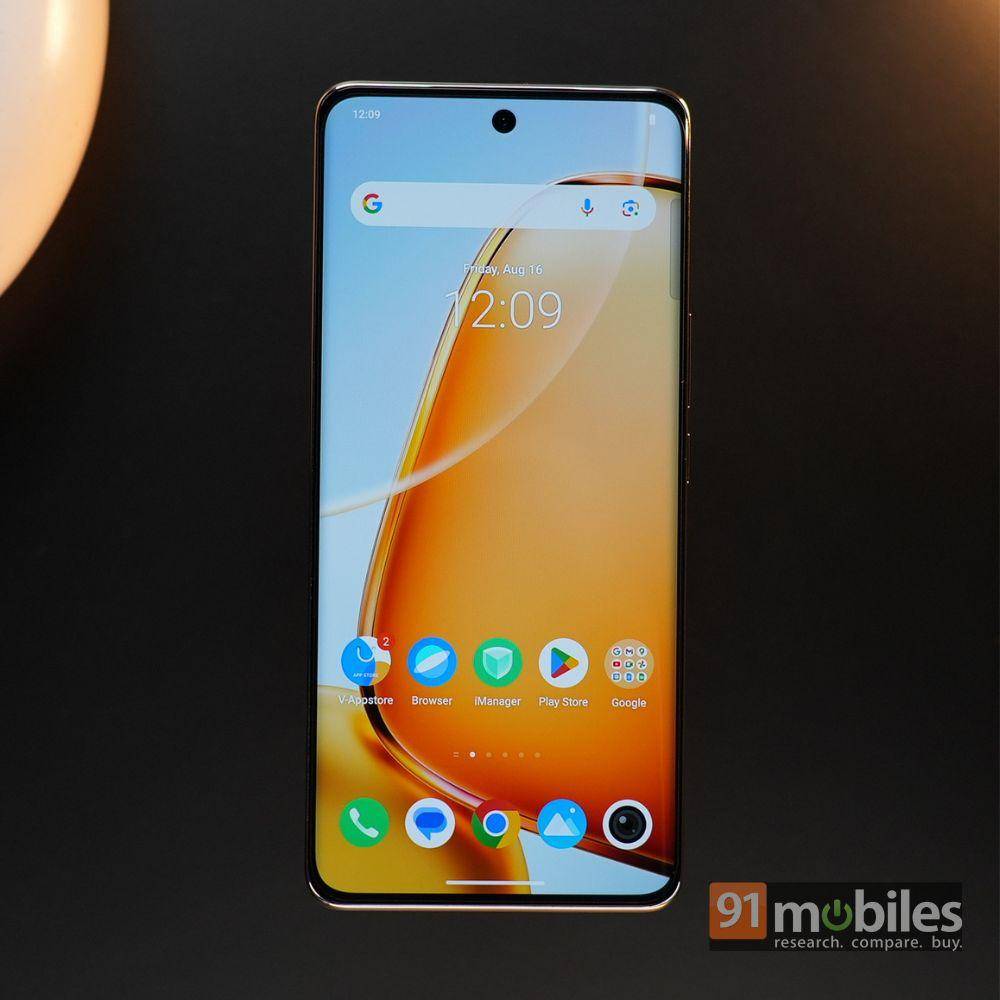
The Vivo T3 Pro flaunts a 6.77-inch AMOLED display with an FHD+ resolution (2392 x 1080p), 120Hz refresh rate and a frankly insane 4,500 nits of peak brightness. While you’re unlikely to hit that number in everyday usage, the general brightness is pretty good both indoors and outdoors, so no issues with legibility. The panel is also very colour rich and has a 100 percent DCI-P3 colour gamut and 105 percent NTSC colour gamut.
While I enjoyed watching content on the display, the colours felt a bit too pronounced for my liking. When I compared it side by side with the Nothing Phone (2a) and OnePlus Nord CE4, it became clear that the display tends to oversaturate, especially with reds and yellows, even at the default colour settings. On the bright side, the stereo speakers deliver decent sound quality, which enhances the overall multimedia experience. Plus, the in-display fingerprint sensor works quickly, making it easy to unlock the phone.
In low light, the camera performs decently but requires up to 3 seconds for long exposure, so any slight movement can blur the shot. With night mode on, the phone adds heavy colour correction, which I personally didn’t like as it strays from the actual scene. The videography could also use a boost. While the rear camera captures decent videos with good stabilisation at 4K 30fps, the front camera lacks 4K support, which may be a letdown for vloggers.
There’s also some camera AI features like AI enhance and AI Eraser, which have been slowly populating latest smartphones. The AI enhancer works but I did not notice a lot of improvement. With AI Eraser, while the function does remove the objects, there’s often some distortion, and the feature needs a little improvement to be useful.
Here’s a direct camera comparison with its key competitors:
Daylight
The Vivo T3 Pro and Nothing Phone (2a) have a very different colour science in their images. The former leans towards a warmer hue, while the latter has a more cooler tone. If you look closely, you’ll see the Nothing Phone (2a) produces a more exposed image with minimal shadows, even in areas where you’d expect them. On the other hand, the Vivo T3 Pro adds more contrast, though it can lack a bit of exposure. The T3 Pro has better sharpness, but neither phone nails colour accuracy perfectly.
Ultrawide
Both the Vivo T3 Pro and Nothing Phone (2a) show consistent colour reproduction in their wide-angle and primary cameras. If you’ll look around the corners, there’s a noticeable warping around the edges of the images in the Phone (2a)’s image, which is not present in the T3 Pro. The Vivo T3 Pro also has better clarity compared to the Nothing Phone (2a) when you zoom in closer.
Portrait
When it comes to portraits, the Nothing Phone (2a) gives stiff competition to the Vivo T3 Pro. The former has better clarity and presents with no noise when zoomed in, unlike the latter. The Vivo T3 Pro instead has a more pleasing colour reproduction, while the Phone (2a)’s image appears washed out.
The Vivo T3 Pro packs a Qualcomm Snapdragon 7 Gen 3 SoC, with up to 8GB of LPDDR4X RAM and 256GB of UFS 2.2 storage. In terms of hardware, it holds its own against competitors in this price range. However, one drawback is the use of UFS 2.2 storage, which falls short compared to rivals like the OnePlus Nord CE4 and POCO X6 Pro, which come with UFS 3.1 and UFS 4.0 storage, respectively.
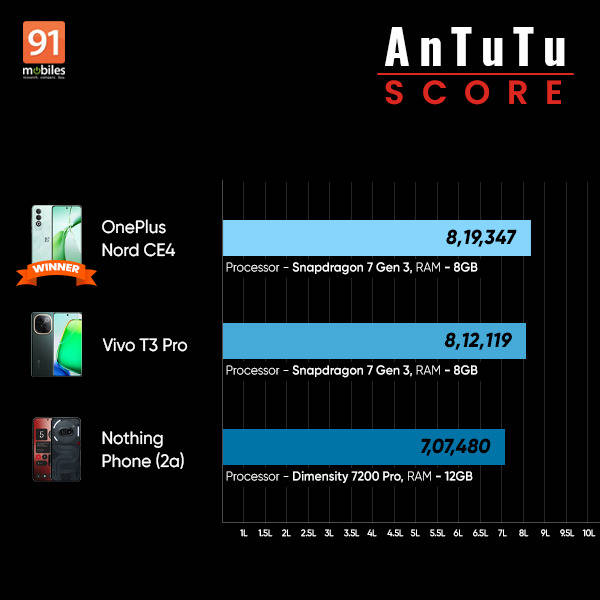
When it comes to benchmarks, the T3 Pro performs excellently in our standard tests, and its scores are on par with the OnePlus Nord CE4, which shares a similar chipset. Although it doesn’t quite match up to outliers like the Infinix GT 20 Pro and POCO X6 Pro. I experienced no lag or jitters during regular use, and the phone ran smoothly throughout. We also tested its gaming performance, and it was a pretty solid experience. The device averaged 50 FPS on high settings in COD: Mobile and about 40 FPS on high settings in BGMI, making it one of the better gaming phones in its price range.
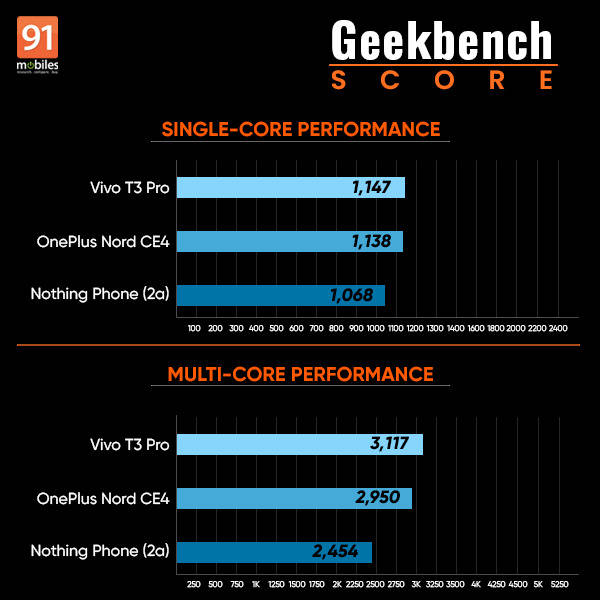
However, it still trails behind top contenders like the Infinix GT 20 Pro (review) and POCO X6 Pro (review). In terms of thermal management, the phone handled heat impressively, with only an 11-degree Celsius increase during gaming—one of the best in its segment. You can check out a more thorough performance comparison between the Vivo T30 Pro and Infinix GT 20 Pro here.
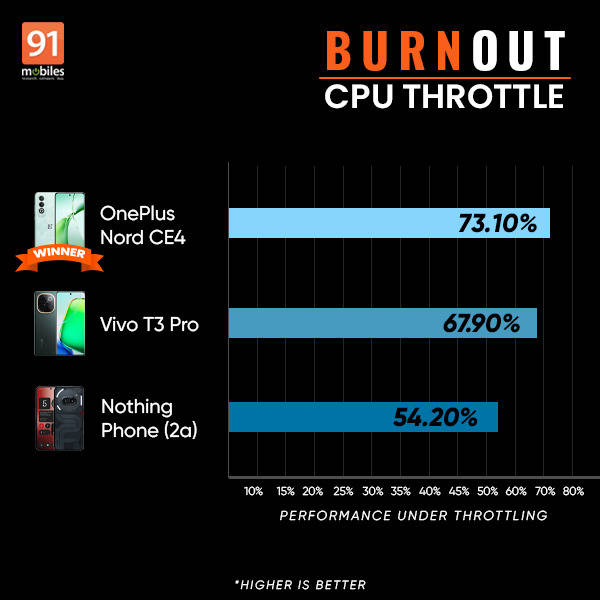
The Vivo T3 Pro runs on Android 14 with Funtouch OS 14, and the UI feels smooth and responsive. It features a handy quick-access sidebar for frequently used apps. The UI, however, can get a bit annoying with constant notifications from apps like the Vivo store, though you can disable them. There’s also a fair amount of pre-loaded apps and random games, which can clutter the interface, but they’re easy to uninstall. The phone is set to receive 2 years of OS upgrades and 3 years of software updates, which is a bit behind competitors like the Nothing Phone (2a), but still fairly reasonable.
Battery & charging
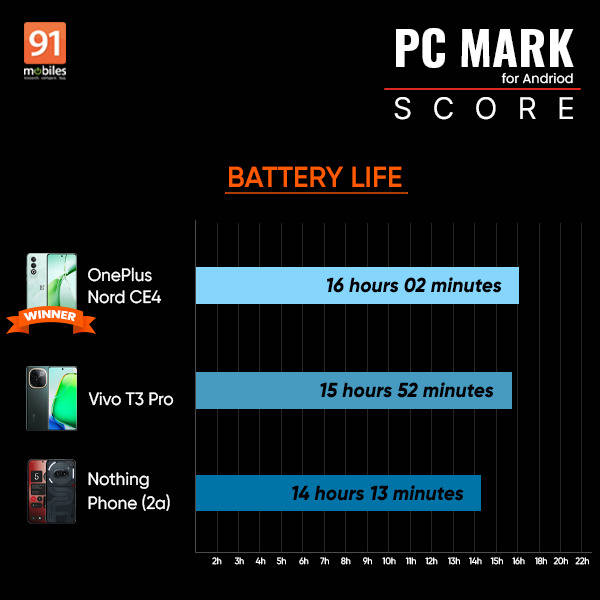
The Vivo T3 Pro comes with a large 5,500mAh battery and 80W fast charging support. Its battery performs well in both benchmarks and real-world tests. In the PCMark battery test, it delivered a solid runtime compared to its rivals, and it easily lasts a full day for most users. After 30 minutes of video playback, the battery drained just 2 percent, which means if you’re a binge-watcher, you’ll get impressive screen-on time.
In gaming, the phone only drained 16% after 1.5 hours of playtime, a great result that should satisfy even heavy users. Looking at the charging speed, the Vivo T3 Pro took just 52 minutes to recharge completely from 20 to 100 percent capacity, which is a pretty decent score for a battery this size.
Final verdict
The Vivo T3 Pro is available in two storage variants: 8GB+128GB for Rs 24,999 and 8GB+256GB for Rs 26,999. Its main rivals are the Nothing Phone (2a) (review) and OnePlus Nord CE4 (review), both of which offer a cleaner user interface. The Nothing Phone (2a) stands out with its unique design and longer software support, while the OnePlus Nord CE4 matches the Vivo T3 Pro in power but offers faster charging and a better selfie camera.
The Vivo T3 Pro brings a lot to the table, offering a bright, vibrant display, versatile cameras, long battery life, and fast charging speeds. It’s also a solid performer, making it a good choice for gaming in its price range. Although the phone has a slightly bloated UI and its selfie camera could be better. But if these factors aren’t dealbreakers, the Vivo T3 Pro is definitely a strong contender worth considering.
Editor’s Rating: 8/10
Reasons to buy Vivo T3 ProThe Vivo T3 Pro has a premium design with an IP64 rating, and its display is quite excellent.
The phone’s rear cameras are very versatile and offer good results
The device packs a capable processor and delivers good performance output and gaming experience
The large 5500mAh battery has excellent backup and charges quickly
Reasons not to buy Vivo T3 ProThe phone’s selfie cameras aren’t as good as its competitors
The UI has a bunch of pre-installed apps and feels cluttered

The Vivo T3 Pro is available in Standstone Orange and Emerald Green colour options.
The rear panel offers a vegan leather finish that looks smooth and comfortable to hold. It also features a big camera module with two camera sensors and an LED light. The right side of the device features volume controls and a power on/off button. You will find a hybrid SIM tray, a USB Type-C port, and a speaker grille at the base.
Coming to the display, the Vivo T3 Pro offers a 6.77-inch Full HD+ curved AMOLED display. The device comes loaded with a 120Hz screen refresh rate and up to 4,500nits of peak brightness, making it one of the brightest displays in this price segment. The screen looks vibrant and smooth during the initial testing period, and you will get to know more in the in-depth review.
The handset features a 6.77-inch curved AMOLED display with 4,500nits of peak brightness.
Like the iQOO Z9s Pro, the Vivo T3 Pro is powered by the Qualcomm Snapdragon 7 Gen 3 processor paired with an Adreno 720 GPU. The chipset is capable of handling most of the tasks you run at it while still delivering an efficient battery life. The review unit I got has 8GB of RAM and 256GB of internal storage. You also have the option to expand the storage up to 1TB via a microSD card slot.
For optics, the Vivo T3 Pro employs a dual-camera setup on the rear panel. The phone features a 50-megapixel Sony IMX882 sensor with OIS support and f/1.79 aperture. It also features an 8-megapixel ultra-wide-angle lens with f/2.2 aperture.
The Vivo T3 Pro features a 50-megapixel Sony IMX882 sensor and an 8-megapixel ultra-wide camera on the rear.
The device packs a 16-megapixel shooter for selfies and video calling. Vivo is heavily banking on the camera capabilities of the Vivo T3 Pro. During the initial testing period, I found out that photos came to be sharp with vibrant colours. The portraits also came out to be clean in daylight conditions. However, I am yet to test out the full capabilities of the Vivo T3 Pro under different lighting conditions.
Lastly, the Vivo T3 Pro also features a 5,500mAh battery and supports 80W fast charging support. The handset also features an in-display fingerprint sensor along with stereo speakers. In terms of connectivity, you get 5G, Wi-Fi 6, Bluetooth 5.4, GPS, and more.
The smartphone packs a 5,500mAh battery with 80W fast charging support.
That said, the Vivo T3 Pro 5G is an interesting option at this price point. However, one of the biggest competitors for this smartphone will be its sibling. Yes, I am talking about the iQOO Z9s Pro, which also offers identical features and specifications. So, the question here is whether you can go for this device or choose the iQOO one. You will shortly get the answer to this question in our upcoming in-depth review. So, stay tuned with us.
Vivo’s new T3 series is all about performance, covering various price ranges from under Rs 15,000 to under Rs 35,000. The Vivo T3x and Vivo T3 were released earlier than the Vivo T3 Pro and Vivo T3 Ultra, and they lead their respective segments in terms of performance. The Vivo T3 Ultra is no slouch either, as it is one of the top performers under Rs 35,000. That brings us to the middle child, the Vivo T3 Pro. On paper, the Vivo T3 Pro certainly packs a punch with its Snapdragon 7 Gen 3 chipset, promising impressive power under Rs 25,000. In this review, I’ll walk you through what day-to-day life with the Vivo T3 Pro looks like.
Verdict
The Vivo T3 Pro offers a bright, vibrant display, versatile cameras, long battery life, and fast charging speeds. It performs well in gaming and everyday tasks, making it a solid choice for most users. While the UI of the device feels a bit bloated and the selfie camera could use some improvement, it delivers strong overall performance.
The Vivo T3 Pro has a chic look, especially the Sandstone Orange variant I got to try. The bright orange hue and vegan leather finish give it a bold vibe, with a large, gold-rimmed camera island that really stands out. The gold-plated sides and Vivo branding add to the overall design harmony. I’m not a huge fan of the colour way, but my friends seemed to love it, so it really comes down to personal taste.
The phone feels incredibly light and comfortable in hand, thanks to the curved edges. At the bottom, you’ve got the Type-C port, speaker grille, and SIM tray, while the volume rockers and power button are placed on the right edge as usual. With an IP64 rating, it’s also got some protection against dust and water splashes, offering a bit more durability.
The Vivo T3 Pro flaunts a 6.77-inch AMOLED display with an FHD+ resolution (2392 x 1080p), 120Hz refresh rate and a frankly insane 4,500 nits of peak brightness. While you’re unlikely to hit that number in everyday usage, the general brightness is pretty good both indoors and outdoors, so no issues with legibility. The panel is also very colour rich and has a 100 percent DCI-P3 colour gamut and 105 percent NTSC colour gamut.
While I enjoyed watching content on the display, the colours felt a bit too pronounced for my liking. When I compared it side by side with the Nothing Phone (2a) and OnePlus Nord CE4, it became clear that the display tends to oversaturate, especially with reds and yellows, even at the default colour settings. On the bright side, the stereo speakers deliver decent sound quality, which enhances the overall multimedia experience. Plus, the in-display fingerprint sensor works quickly, making it easy to unlock the phone.
Cameras
The Vivo T3 Pro sports a dual rear camera setup, featuring a 50MP Sony IMX882 primary sensor and an 8MP ultra-wide lens. On the front, there’s a 16MP camera for selfies and video calls. In daylight, the phone delivers vibrant photos with a good dynamic range, though the contrast is a bit high, giving images a more dramatic feel.In low light, the camera performs decently but requires up to 3 seconds for long exposure, so any slight movement can blur the shot. With night mode on, the phone adds heavy colour correction, which I personally didn’t like as it strays from the actual scene. The videography could also use a boost. While the rear camera captures decent videos with good stabilisation at 4K 30fps, the front camera lacks 4K support, which may be a letdown for vloggers.
There’s also some camera AI features like AI enhance and AI Eraser, which have been slowly populating latest smartphones. The AI enhancer works but I did not notice a lot of improvement. With AI Eraser, while the function does remove the objects, there’s often some distortion, and the feature needs a little improvement to be useful.
Here’s a direct camera comparison with its key competitors:
Daylight
The Vivo T3 Pro and Nothing Phone (2a) have a very different colour science in their images. The former leans towards a warmer hue, while the latter has a more cooler tone. If you look closely, you’ll see the Nothing Phone (2a) produces a more exposed image with minimal shadows, even in areas where you’d expect them. On the other hand, the Vivo T3 Pro adds more contrast, though it can lack a bit of exposure. The T3 Pro has better sharpness, but neither phone nails colour accuracy perfectly.
Ultrawide
Both the Vivo T3 Pro and Nothing Phone (2a) show consistent colour reproduction in their wide-angle and primary cameras. If you’ll look around the corners, there’s a noticeable warping around the edges of the images in the Phone (2a)’s image, which is not present in the T3 Pro. The Vivo T3 Pro also has better clarity compared to the Nothing Phone (2a) when you zoom in closer.
Portrait
When it comes to portraits, the Nothing Phone (2a) gives stiff competition to the Vivo T3 Pro. The former has better clarity and presents with no noise when zoomed in, unlike the latter. The Vivo T3 Pro instead has a more pleasing colour reproduction, while the Phone (2a)’s image appears washed out.
Performance & software
The Vivo T3 Pro packs a Qualcomm Snapdragon 7 Gen 3 SoC, with up to 8GB of LPDDR4X RAM and 256GB of UFS 2.2 storage. In terms of hardware, it holds its own against competitors in this price range. However, one drawback is the use of UFS 2.2 storage, which falls short compared to rivals like the OnePlus Nord CE4 and POCO X6 Pro, which come with UFS 3.1 and UFS 4.0 storage, respectively.
When it comes to benchmarks, the T3 Pro performs excellently in our standard tests, and its scores are on par with the OnePlus Nord CE4, which shares a similar chipset. Although it doesn’t quite match up to outliers like the Infinix GT 20 Pro and POCO X6 Pro. I experienced no lag or jitters during regular use, and the phone ran smoothly throughout. We also tested its gaming performance, and it was a pretty solid experience. The device averaged 50 FPS on high settings in COD: Mobile and about 40 FPS on high settings in BGMI, making it one of the better gaming phones in its price range.
However, it still trails behind top contenders like the Infinix GT 20 Pro (review) and POCO X6 Pro (review). In terms of thermal management, the phone handled heat impressively, with only an 11-degree Celsius increase during gaming—one of the best in its segment. You can check out a more thorough performance comparison between the Vivo T30 Pro and Infinix GT 20 Pro here.
The Vivo T3 Pro runs on Android 14 with Funtouch OS 14, and the UI feels smooth and responsive. It features a handy quick-access sidebar for frequently used apps. The UI, however, can get a bit annoying with constant notifications from apps like the Vivo store, though you can disable them. There’s also a fair amount of pre-loaded apps and random games, which can clutter the interface, but they’re easy to uninstall. The phone is set to receive 2 years of OS upgrades and 3 years of software updates, which is a bit behind competitors like the Nothing Phone (2a), but still fairly reasonable.
Battery & charging
The Vivo T3 Pro comes with a large 5,500mAh battery and 80W fast charging support. Its battery performs well in both benchmarks and real-world tests. In the PCMark battery test, it delivered a solid runtime compared to its rivals, and it easily lasts a full day for most users. After 30 minutes of video playback, the battery drained just 2 percent, which means if you’re a binge-watcher, you’ll get impressive screen-on time.
In gaming, the phone only drained 16% after 1.5 hours of playtime, a great result that should satisfy even heavy users. Looking at the charging speed, the Vivo T3 Pro took just 52 minutes to recharge completely from 20 to 100 percent capacity, which is a pretty decent score for a battery this size.
Final verdict
The Vivo T3 Pro is available in two storage variants: 8GB+128GB for Rs 24,999 and 8GB+256GB for Rs 26,999. Its main rivals are the Nothing Phone (2a) (review) and OnePlus Nord CE4 (review), both of which offer a cleaner user interface. The Nothing Phone (2a) stands out with its unique design and longer software support, while the OnePlus Nord CE4 matches the Vivo T3 Pro in power but offers faster charging and a better selfie camera.
The Vivo T3 Pro brings a lot to the table, offering a bright, vibrant display, versatile cameras, long battery life, and fast charging speeds. It’s also a solid performer, making it a good choice for gaming in its price range. Although the phone has a slightly bloated UI and its selfie camera could be better. But if these factors aren’t dealbreakers, the Vivo T3 Pro is definitely a strong contender worth considering.
Editor’s Rating: 8/10
Reasons to buy Vivo T3 ProThe Vivo T3 Pro has a premium design with an IP64 rating, and its display is quite excellent.
The phone’s rear cameras are very versatile and offer good results
The device packs a capable processor and delivers good performance output and gaming experience
The large 5500mAh battery has excellent backup and charges quickly
Reasons not to buy Vivo T3 ProThe phone’s selfie cameras aren’t as good as its competitors
The UI has a bunch of pre-installed apps and feels cluttered
Tags
VIVO