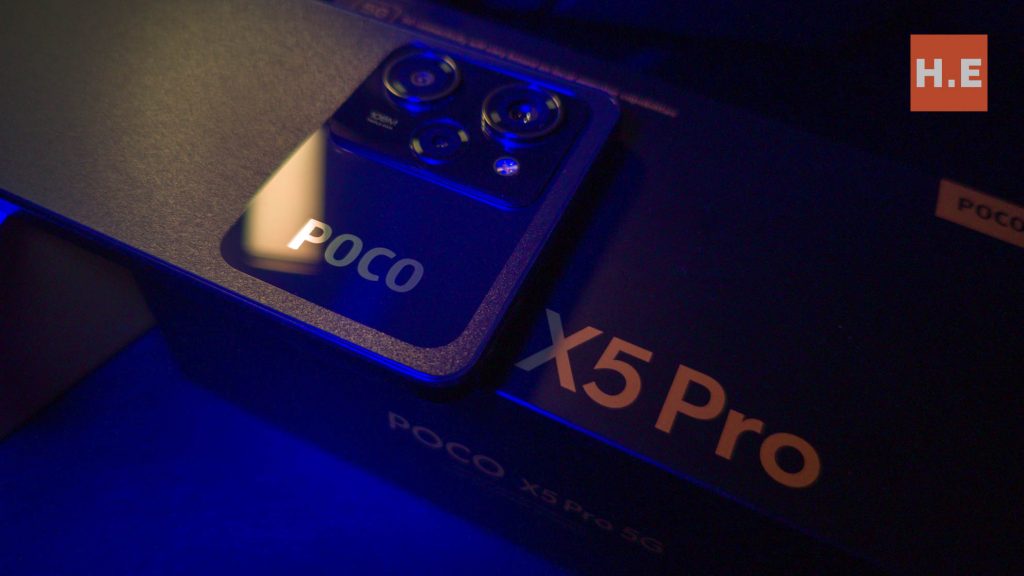
The POCO X5 Pro 5G comes across as an iterative upgrade to the POCO X4 Pro smartphone (review), which was one of the most promising smartphones under Rs 20,000 last year. The new X5 Pro 5G has the same general shape and size as its predecessor, but the handset comes with a new chipset and a slightly better camera setup. There are other minor improvements on the phone as well, which you shall get to know in the POCO X5 Pro 5G review below. So, without any further ado, let’s get started:
Verdict
The POCO X5 Pro 5G might not set new benchmarks, but that doesn’t mean it is not a capable smartphone. Despite its age-old chipset, the handset does not disappoint at all with its performance. It even offers a good viewing experience with its rich AMOLED screen and stereo speakers, while the cameras are more or less on par with its competitors. The phone’s battery life feels a bit underwhelming for a 5G device, but the 67W fast charging solution compensates for that.
The lowdown

- Design-wise, it hasn’t changed much for the new POCO X-series smartphone. The POCO X5 Pro 5G still rocks the same flat edges and a centred punch-hole display as introduced last year. Even the ports, buttons, and stereo speakers placements are unchanged. The 3.5mm headphone jack is inconveniently placed on the top edge of the smartphone, alongside the speaker grille and an IR Blaster. The bottom edge packs a USB Type-C port sandwiched in between the secondary speaker grille and a SIM ejector tray. All the buttons are on the right fascia of the handset, with the power button rocking a fingerprint scanner, which unlocks the device in a jiffy.
- That is not to say the POCO X5 Pro 5G looks exactly like its predecessor. POCO has tweaked the handset’s back panel ever so slightly to give it a new look. The X5 Pro 5G now comes with frosty glass around the back instead of glossy which does a good job of hiding fingerprints and smudges. Furthermore, there is no oversized camera bump. This has been replaced by a small rectangular module that houses triple cameras and an LED flash. The module has a shiny finish that extends all the way to the POCO branding and adds a good contrasty look to the phone. That said, the X5 Pro’s camera juts out of the frame quite a bit and makes the device wobble while lying flat on a surface. Be that as it may, the smartphone is nicely built. It has a plastic unibody design that does not creak or flex when pressure is applied. The handset is also just about thin and lightweight to make it feel comfortably snug in hand. The phone comes in at 7.9mm in thickness and 181 grams. There’s even an IP53 rating for dust and splash protection.

- The POCO X5 Pro 5G also shares a few traits with the X4 Pro in the display department. The 6.67-inch AMOLED display with Corning Gorilla Glass 5 protection, FHD+ (2,400 x 1,080p) resolution, 120Hz refresh rate, and DCI-P3 wide colour gamut remain unchanged. However, POCO claims the X5 Pro 5G has slimmer bezels than the previous-gen X-series offering. The handset also has Dolby Vision and HDR10+ support available out of the box for true picture quality. Additionally, the display can exhibit over 1 billion colours through 10-bit technology and a high 5,000,000:1 contrast ratio. All that translates to an ultra-immersive viewing experience with life-like colours and deep blacks. The POCO smartphone is Widevine L1 certified too. The handset can stream content in FHD resolution from OTT platforms.
- The viewing angles are excellent on this device as well, while the 120Hz refresh rate feels smooth across UI and supported apps. The refresh rate on the POCO X5 Pro 5G can either adjust dynamically based on the content played on the screen to reduce power consumption or stay locked in at preferred settings between 60Hz and 120Hz. I wish the handset also had a 90Hz refresh rate support, but that aside, this is an excellent screen to look at both indoors and outdoors. The display is paired with Dolby Atmos-backed stereo speakers, which are loud and balanced for consuming multi-media stuff and playing games. Moreover, the audio setup hardly distorts at maximum volume.

- The POCO X5 Pro 5G has Snapdragon 778G SoC ticking at its core. This is a 6nm chipset with eight Kyro 670 cores and up to 2.4GHz clock speed. The chipset is aided by Adreno 642L GPU and 6GB/ 8GB of RAM + 3GB of virtual RAM. As for the storage, the phone has up to 256GB UFS 2.2 ROM onboard, which is not user-expandable. So, choose the variant wisely. With that out of the way, let’s talk about the performance. Synthetically, the handset performed better than some of the MediaTek Dimensity 1080 SoC-powered phones in the price range. The device delivered 5,25,085 points on AnTuTu, while its Geekbench 5’s multi-core score was 2,943. Additionally, there was no performance throttle while running 50 threads for half an hour on the CPU Throttle test. As impressive as it may sound, I did notice some minor heating on a 12-layered graphite cooling phone. But you have to understand the device was pushed to its limit, and some thermal issues were inevitable.
- In daily usage, the handset did not heat up whatsoever in Delhi’s February weather. The two-year-old chipset coolly handled everything thrown at it. Free Fire Max at ‘Ultra’ graphics and ‘Normal’ resolution ran smoothly on the smartphone, while multi-tasking, with a dozen Chrome tabs open and a bunch of apps running in the background, worked like a charm. My only qualm with the POCO X5 Pro is that it doesn’t pack the latest mid-range Snapdragon 7 Gen 1 SoC from Qualcomm. The SoC is more power and battery-efficient than the Snapdragon 778G chipset. This brings me to the POCO X5 Pro’s battery life.
- The POCO X5 Pro packs a 5,000mAh battery, which is the same as last year; however, its PC Mark 3.0 battery benchmark test score was significantly lower. The handset could only return a score of 12 hours and 15 minutes. To give you some perspective, the POCO X4 Pro scored 16 hours and 57 minutes on the same test. Be that as it may, the handset lasted me close to a day between charges, with usage involving going through emails, checking Slack, streaming an episode or two of a web series, playing games, and browsing. I didn’t find the need to plug the phone in for charging before going to bed. Good thing though the X5 Pro is backed by a 67W fast charging solution, which takes around 45 minutes for a full charge from nothing.
- In terms of optics, the POCO X5 Pro 5G packs triple rear cameras, which comprise a 108MP Samsung ISOCELL HM2 primary sensor paired with an 8MP ultra-wide lens and a 2MP macro sensor, while the front camera is a 16MP shooter. The 108MP sensor captures images in 12MP resolution by default. The results looked good in sunny and bright environments. The images captured had ample detail, and there was hardly any issue with the sensor’s shutter speed and focus. That said, the HDR on POCO X5 Pro over-saturates the colours slightly. It does make the images more likeable and social media-ready, which is what most people want, but not ‘photophiles’. The latter group might not like the handset’s extra processing, where RGBs are enhanced to make the images look more vibrant and peppy. Moreover, the 108MP sensor creates a shallow depth of field, which blurs the background, if you get close to the subject. The lowlight photography of the sensor was not quite as good as I expected, but the results were usable. The night mode does a nice job of brightening the image while keeping the noise level down and preserving the key details.

- The X5 Pro 5G uses a typical 8MP ultra-wide lens for landscape shots found in other budget and mid-range smartphones. The lens offers a wider 120-degree field of view (FOV) than the primary camera. However, due to its small sensor size, the images appeared gloomy, owing to the low dynamic range and contrast ratio, even in daylight. The colours also seemed muted. In low light, the sensor performed average at best. Besides this, the phone uses a 2MP macro shooter, which does a decent job of taking pictures of subjects up close. This is true as long as there is enough light source and frame stability. The X5 Pro doesn’t ship with a dedicated depth sensor, but there is a software-based portrait mode that offers impressive results with the 108MP primary camera. The edge detection and background blur both worked like a charm. The front-facing 16MP sensor of the phone captured selfies with good facial detailing and accurate skin tones when the sun was out. However, the portrait mode of the sensor was hit-and-miss as it had some trouble with edge detection.

- Software-wise, the POCO X5 Pro has the latest custom skin MIUI 14 running atop the slightly dated Android 12 OS out of the box. Much like the previous MIUI build, the new custom Android skin is also bereft of advertisements. The phone has a few pre-installed apps, but they can be uninstalled. That said, most of the MIUI 14 features are missing on the POCO X5 Pro, while the animation and UI look pretty much the same as the 13. This could be due to Android 12. Once Android 13 is rolled out, the device may get all the features of MIUI 14. POCO promises two years of major software and three years of security updates for the X5 Pro smartphone. The 5G-enabled smartphone supports as many as seven bands in India and is compatible with both Airtel 5G and Jio 5G networks.
Final verdict
The POCO X5 Pro 5G does not come cheap, and the handset is the most-expensive X-series smartphone in India yet. But this shouldn’t come as a surprise to you as prices of the handsets across segments have been increasing lately. The X5 Pro 5G competes against the Realme 10 Pro Plus (review), with which it has a lot in common. However, the Realme smartphone runs Android 13 out of the box, which isn’t the case with the POCO phone. The X5 Pro also lags behind in the camera department, which has a 108MP HM2 primary sensor instead of the latest 108MP HM6 sensor.
Having said that, the POCO X5 Pro does a better job than its counterpart in the performance and display departments. The handset also has a good audio setup to go with that beautiful screen. What’s more, the smartphone is more affordable than the Realme 10 Pro Plus. These things make the POCO X5 Pro 5G smartphone a good buy for its price, at least for now. The handset is selling in India at Rs 22,999 for the 6GB RAM variant, while the 8GB RAM option is priced at Rs 24,999.
Editor’s rating: 3.5 / 5
Pros
- Thin and lightweight
- Lovely AMOLED screen
- Stereo speakers
- Decent battery life
Cons
- Protruding rear camera’s wobble is irksome
- Chipset could have been better
- Runs Android 12 out of the box

The Poco X5 Pro 5G's display has a peak brightness of 900 nits
Like its predecessor, the Poco X5 Pro 5G supports a 120Hz refresh rate. The screen can vary the refresh rate between 30Hz, 60Hz, 90Hz and 120Hz, depending on the usage. For instance, when watching videos, the screen refreshes at 60Hz, but while scrolling through the interface, it refreshes at 120Hz. When the lockscreen Always-on-Display (AoD) is enabled, the phone's display refreshes at 30Hz. A few compatible games can also take advantage of the 120Hz refresh rate.
Poco X5 Pro 5G specifications and software
The Poco X5 Pro 5G features a Qualcomm Snapdragon 778G SoC. The 6nm SoC also features an Adreno 642L GPU and is paired with LPDDR4X RAM and UFS 2.2 storage. The X5 Pro also supports seven 5G bands in India. Connectivity options include dual-band Wi-Fi ac, Bluetooth 5.1, and a USB Type-C port.
In terms of software, the Poco X5 Pro 5G ships with the Android 12-based MIUI 14. For a phone priced above Rs. 20,000 in 2023, not having the latest Android version is disappointing. The new MIUI update has features that improve the overall performance such as using less memory and being more power efficient.

While the Poco X5 Pro 5G gets MIUI 14, it is still based on Android 12 out of the box
The custom skin continues to offer a bunch of customisation and personalisation options. Users can choose between two different styles for the Control Centre. There are also options for customising the Always-on-Display screen, changing wallpapers and themes, adjusting the animation speed, etc.
In addition to this, you get the Android Privacy Dashboard, which is a one-stop location for checking which apps have access to your location, contacts, call logs, photos and media, microphone, etc. There is also the privacy indicator at the top right to highlight when an app uses the camera or microphone.
The Poco X5 Pro 5G does come with a few pre-installed third-party apps, such as Amazon, Moj, Zilli, Prime Video, etc. You can choose to uninstall these apps whenever you want. There is also an option to setup Glance for wallpaper recommendations on the lockscreen.
Even if you do not enable it while setting up the phone, the software tends to throw a pop-up intermittently in case you would want to reconsider. Sadly, there is no way to stop this notification. Get Apps, Xiaomi's native app store, also spams you with some notifications during the day to remind you of updating apps or consider installing some recommendations.

The Poco X5 Pro comes with a few third-party apps pre-installed
Poco has promised to offer two major Android updates for the X5 Pro 5G. This means that the Android 13 update should be available later this year, although it is unknown when exactly this will happen.
Poco X5 Pro 5G performance and battery life
The Poco X5 Pro 5G is a great option for those who play a lot of games on their smartphone but do not necessarily want to spend a premium. The Snapdragon 778G is a capable processor for handling certain resource-hungry tasks, let alone day-to-day routine stuff.
I played Call of Duty: Mobile on the Poco X5 Pro 5G at the 'Very High' graphics and 'Max' framerate settings, and the experience was quite fun. There was no sign of any stutter or lag while playing team deathmatch or multiplayer rounds. The game also lets you choose ‘Ultra' framerate as an option with ‘Low' or ‘Medium' graphics quality on the X5 Pro 5G. Asphalt 9 Legends also ran smoothly on the Poco X5 Pro 5G.
I also ran a few benchmark tests on the Poco X5 Pro 5G. The phone scored 5,31,029 points in AnTuTu, which is very close to the claimed score of 5,45,093 points. The Realme 10 Pro+ 5G, which is closest in terms of price, scored 5,04,626 points, whereas the Redmi Note 12 Pro+ 5G scored 4,38,678 points. In Geekbench, the Poco X5 Pro scored 755 and 2819 points in the single-core and multi-core tests, respectively. RAM management is quite good on the Poco X5 Pro 5G. Games load a bit faster when the Game Turbo mode kicks in.

The Poco X5 Pro 5G supports 67W fast charging via a USB Type-C port
The Poco X5 Pro 5G's 5,000mAh battery can easily a full day on one charge. The phone, on average, delivered eight hours of screen-on time( SoT) when I played games or recorded videos using the camera. On days when my use case was lighter, the SoT was about nine hours. Your mileage might vary depending on how you use it.
In our HD video loop test, the Poco X5 Pro 5G lasted for 17 hours and 32 minutes. The 67W fast charging adapter charged the battery from zero to 100 per cent in 47 minutes. The phone did get a bit hot near the camera module area while charging.
Poco X5 Pro 5G camera
The Poco X5 Pro 5G has a triple rear camera setup. There is a 108-megapixel Samsung HM2 main camera, an 8-megapixel ultra-wide camera and a 2-megapixel macro camera. There is no optical image stabilisation (OIS) for the primary camera. The phone also feature a 16-megapixel front camera sensor.

The Poco X5 Pro 5G camera module design is inspired by its cousin, Redmi Note 12 Pro series
The primary camera captures detailed, vibrant shots during the day. However, when HDR kicked in, I noticed that the reds and greens were slightly more saturated than usual. The dynamic range performance is good but there is room for improvement. Also, there are times when the sky looks unusually blue but this can be fixed in post.
The 1/1.52-inch Samsung ISOCELL HM2 sensor, when using Night mode, also does a good job in retaining details in the shadows. I did miss OIS at times though as even a slight shake would result in blurry images.