

One brand for us that has consistently pushed flagship models and re-defined them is iQOO. Vivo’s sub-brand has carved a name for itself by delivering performance-driven smartphones at competitive prices. The previously launched iQOO 12 garnered a lot of praise last year, and keeping the momentum going, the brand is back with its latest flagship — iQOO 13. It’s among the first phones in India and, for me, the second to feature the Snapdragon 8 Elite SoC, Qualcomm’s top-tier processor, along with a host of upgrades, including a brighter display, bigger battery, and a refreshed design. Starting at ₹54,999, the iQOO 13 competes against the Realme GT 7 Pro.
Design
The iQOO 13’s design strikes a perfect balance between elegance and functionality. Measuring 8.1mm in thickness and weighing around 213 g, it is a sizable phone, yet the chamfered sides and curved aluminium frame make it comfortable to hold. The matte finish glass back looks premium, especially in the Legend variant which we got to review. It shows off iQOO’s subtle partnership with BMW M Motorsport.
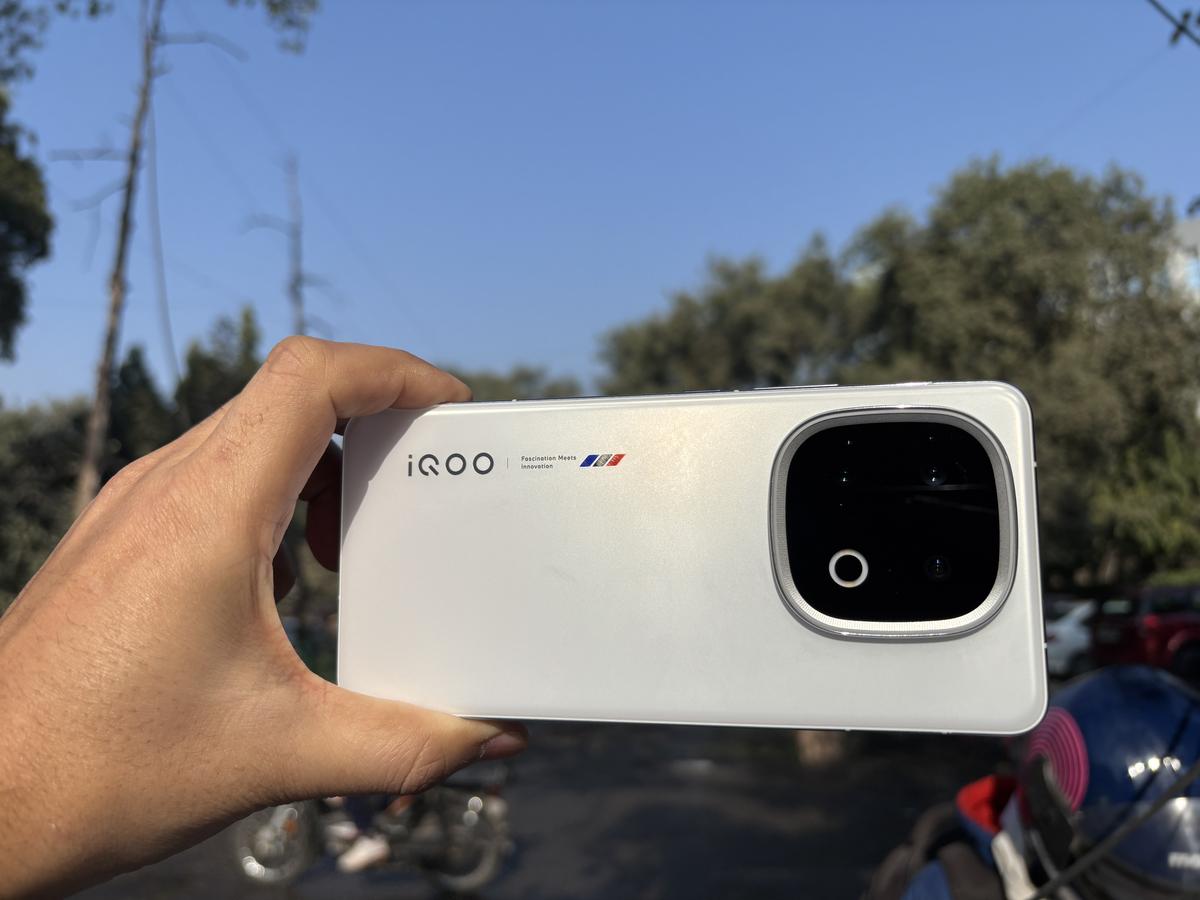
iQOO 13’s design | Photo Credit: Haider Ali Khan
The attention to detail is excellent. You get an RGB LED strip around the camera module, called ‘Monster Halo’, which works as a notification light or enhances your gaming experience. While not overly bright, it’s a cool addition. The IP68/IP69 rating ensures the phone is protected against dust and water, adding durability to its premium design. Another highlight is the ultrasonic fingerprint scanner embedded within the screen which is faster and accurate.
The button placement is ergonomic, with the power and volume buttons on the right. The bottom houses the USB Type-C port, SIM tray, microphone, and loudspeaker, while the top frame includes the second loudspeaker, another mic, and an IR blaster. Overall, the iQOO 13 nails the flagship phone aesthetic.
(For top technology news of the day, subscribe to our tech newsletter Today’s Cache)
Display
The iQOO 13 features a 6.82-inch Q10 AMOLED display with a 2K resolution and a 144 Hz refresh rate. It’s a significant upgrade, particularly in terms of brightness, with 4,500 nits peak brightness and 1,800 nits HBM. This makes outdoor visibility excellent, even under direct sunlight. The display also boasts a 300 Hz touch sampling rate, ensuring quick touch responses, which is ideal for gamers.
The bezels are slim and uniform, and the panel supports 10-bit colours, HDR10, and Widevine L1, making it perfect for streaming and multimedia. You can switch between Full HD and QHD resolution or toggle the refresh rate between Smart Switch (Auto), Standard (60Hz), and High (144Hz).
OS
Running on Funtouch OS 15, based on Android 15, the iQOO 13 delivers a mostly clean software experience. iQOO promises 4 years of OS updates and 5 years of security patches, making this a long-term investment. While there are a few pre-installed apps, they can be uninstalled easily, and overall bloatware is minimal.
The phone features AI tools like AI Erase and AI Enhancement in the Gallery app, which let you remove objects and reduce image blur. These tools worked well in our testing. You also get Google’s Circle to Search and Dynamic Light controls for the LED strip at the back. However, more AI features are expected to roll out in future updates, which is something to look forward to.
Processor
The iQOO 13 is all about raw performance. It features the latest Snapdragon 8 Elite SoC, paired with 16 GB LPDDR5x RAM and 512 GB UFS 4.1 storage. This processor is blazing fast, handling every task you throw at it with ease. Animations, app loading, and multitasking feel smooth and snappy.
For gamers, the iQOO 13 is a dream come true. We played demanding titles like BGMI, COD, Asphalt and Genshin Impact at the highest graphics settings without any hiccups. Even after hours of intense gaming, the phone didn’t slow down, thanks to the 7,000mm² vapor chamber cooling that keeps thermals under control. Yes, the frame gets slightly warm, but it’s nothing alarming.
The dual stereo speakers offer loud and clear audio with decent bass, further enhancing the gaming and multimedia experience. Connectivity features like Wi-Fi, Bluetooth, and NFC worked seamlessly during our testing. Overall, the iQOO 13 sets a new benchmark for Android performance.
In terms of benchmarks, the iQOO 13 takes a close lead against the Realme GT 7 Pro. The iQOO 13 achieves a Single-core score of 3104, a Multi-core score of 9802, and a GPU score of 18,654, whereas the Realme GT 7 Pro scores 3016 in single-core, 8945 in multi-core, and 18,240 for the GPU.
Camera
The iQOO 13 features a triple-camera setup comprising a 50 MP primary sensor (Sony IMX921) with f/1.88 aperture and OIS, a 50 MP telephoto lens (Sony IMX816) with 2x optical zoom, and a 50 MP ultra-wide sensor (Samsung JN1) with an f/2.0 aperture. On the front, there’s a 32 MP selfie camera that produces sharp and detailed results. While the absence of a periscope lens is noticeable compared to the iQOO 12, the overall camera system offers versatile and reliable performance.
The primary 50 MP sensor excels in daylight, capturing sharp, vibrant, and well-detailed photos with excellent dynamic range and natural colors. It handles highlights and shadows well and locks focus quickly, ensuring sharp results. In low light, the Night Mode boosts exposure and detail while reducing noise, delivering clear and balanced shots even in challenging conditions.

iQOO 13 camera sample | Photo Credit: Haider Ali Khan
The 50 MP telephoto lens provides 2x optical zoom with impressive detail and colour consistency. Portrait shots stand out with accurate edge detection and a pleasing bokeh effect, making images look professional. While the 2x zoom is sharp, software cropping up to 4x zoom remains usable, albeit with slight detail loss.

iQOO 13 camera sample | Photo Credit: Haider Ali Khan
The 50 MP ultra-wide lens captures expansive landscapes with minimal edge distortion and consistent colour reproduction. Close-up shots from this lens also perform surprisingly well, retaining fine details and textures. While night shots from ultra-wide and telephoto lenses can soften details, Night Mode improves clarity significantly.

iQOO 13 camera sample | Photo Credit: Haider Ali Khan
The 32 MP front camera delivers sharp, natural selfies with good skin tones and dynamic range in daylight. Portrait selfies impress with clean edge detection and smooth bokeh. Even in low light, it maintains decent results with slight softness.
For videos, the iQOO 13 supports up to 8K at 30fps, offering sharp, stable, and detailed footage. The 4K video excels with colour accuracy and dynamic range, while ultra-stabilisation at 1080p ensures smooth recording. Overall, the iQOO 13 offers a well-rounded camera experience suitable for varied use cases.
Battery
The new iQOO 13 ships with a 6,000 mAh battery. With such battery power, the phone lasts a day comfortably. Charging is incredibly fast, thanks to the 120 W FlashCharge. The phone goes from 1% to 100% in just 42-45 minutes. On some occasions, the device gets slightly warm during charging, however optimised charging settings help preserve battery health. Surprisingly, there’s no wireless charging support, which is a minor downside for a flagship.
Verdict
The iQOO 13 is a performance powerhouse that punches well above its weight. With the Snapdragon 8 Elite SoC, a stunning 144 Hz 2K AMOLED display, excellent battery life, and super-fast charging, it stands out as one of the best-performing phones in its segment. While the camera performance takes a small step back due to the lack of a periscope lens, and wireless charging is still missing, the model excels in almost every other aspect. If raw performance, gaming, and a fantastic display are your priorities, the iQOO 13 is an easy recommendation.
iQOO, a sub-brand of Vivo, is known for making phones that are performance-focused and value for money. After the success of the iQOO 12 from last year, the brand is now back with another flagship, which, on paper, seems like another performance monster. The iQOO 13 is the latest phone from the brand, and it's one of the first phones to launch in India with the Snapdragon 8 Elite SoC. Apart from using the top-of-the-line flagship processor from Qualcomm, the 13 also brings a new display, larger battery, and slightly updated design.The iQOO 13 is now slightly more expensive than the outgoing model, starting at Rs. 54,999 for the base variant with 12GB RAM and 256GB storage and Rs. 59,999 for the 16GB 512GB option. In this review, we're going to tell you if it's worth the extra cash.
iQOO 13 Design: Premium and stylish
- Dimensions - 163.37x76.71x8.13mm
- Weight - 213g
- Colours - Nardo Grey and Legend
The iQOO 13 is a good-looking rectangular slab that, despite its size, doesn't feel massive in hand. While it looks very similar to last year's iQOO 12 (Review), there are some changes. The phone gets a matte/satin finish glass rear panel with chamfered sides and a flat aluminium frame with curved, rounded edges. The rear panel is slippery, but the glossy frame provides a somewhat secure grip. You do get a clear grippy case in the bo, though. The frame has a metallic finish to it and gathers fingerprints, but the rear panel on our Legend variant keeps the fingerprints and smudges away. The Nardo Grey option is, unfortunately, a fingerprint magnet.
The phone is just 8.1mm thick, but the rear camera module does protrude out. The module now has an RGB LED strip called ‘Monster Halo'. You can use the strip as a notification light or while gaming. It's not very bright, but it does the job of notifying you.

You can use the LED strip around the camera island as a notification light
iQOO 13 now comes with an IP rating. It gets IP68/IP69 ingress protection against dust and water. We removed the SIM tray and found that it uses a rubber seal. The phone houses its power and volume buttons on the right frame. You'll find the SIM tray, USB Type-C port, and a loudspeaker at the bottom, along with a microphone. The top houses the second loudspeaker and another microphone. The phone also has an IR blaster inside the rear camera module and NFC support.
You'll find a new and improved ultrasonic fingerprint scanner on the iQOO 13, a step up from the standard optical unit found on the 12. The scanner was fast and accurate throughout the review period. It was also placed at a comfortable height from the bottom of the display.
iQOO 13 Software: Plenty of customisation and some AI
- OS - Android 15
- UI - Funtouch OS 15
- Latest security patch - 1 October 2024
The iQOO 13 runs the latest Funtouch OS 15, based on Android 15. iQOO has promised 4 years of OS updates and 5 years of security patches. The phone offers a mostly clean software experience apart from a few preinstalled apps and games. Luckily, all of this can be uninstalled. There's not a lot of bloatware on the phone, but there's also not a lot of AI features on the device, especially when the entire smartphone industry is after AI. IQOO will likely start bringing new AI features with future software updates.

The phone will get updates until Android 19
For now, you get AI erase and AI enhancement tools in the Gallery app, which do right by their name. The AI erase lets you remove objects, people, and distractions from an image, and it performed quite well when we tried it. The AI enhancement tool, meanwhile, tries to get rid of blur from pictures and also did a decent job in our testing. Apart from this, you get Google's Circle to Search, Live Transcribe, and a Dynamic Light feature to control the LED array at the back.
iQOO 13 Performance: Like a BMW M4, it is incredible
- Processor - Snapdragon 8 Elite
- RAM - 12/16GB LPDDR5x
- Storage - 256/512GB UFS 4.1
- GPU - Adreno 830
iQOO has always gone after performance figures and delivering a super smooth gaming experience on its number series, which continues with the 13. The iQOO 13 can run any game you throw at it, and it can run the game at the highest graphics settings possible. The new Snapdragon 8 Elite SoC is super fast, and using the phone is like driving a BMW M4 or M2 Competition. The chip features a new core layout compared to last year's Snapdragon 8 Gen 3 and uses custom Oryon cores that offer up to 4.32GHz clock speeds. You also get a new Q2 supercomputing chip developed by iQOO that is said to improve gaming performance while being efficient.

When it comes to real-world usage, the phone continues to perform superbly, and we have never once faced any kind of lag. Animations, app opening/loading, multi-tasking, and almost every other task are a piece of cake for the iQOO 13.
As for gaming, the phone is an easy recommendation. We ran a couple of games, such as BGMI and Genshin Impact, on the phone. The latter ran smoothly at the Highest graphics setting and frame rate. Even BGMI worked flawlessly when set to the maximum available graphics options.
In terms of heat, we were also able to run the games for over two hours without running into any major issues. Even a 3-hour gaming test didn't slow down the phone despite the frame getting hot to the touch. The phone features a 7,000 mm2 Vapor Chamber, which is what helps keep the heat under control.
iQOO 13 offers dual stereo speakers, and the sound output is pretty good. The speakers get loud and offer some bass as well. The earpiece and microphone also perform very well, and we didn't face any issues during voice calls. Haptics on the phone provide decent feedback, nothing out of the ordinary. Wi-Fi and Bluetooth performance is also top notch, and we didn't face any connectivity issues during the review.
iQOO 13 Cameras: Mostly good
- Primary - 50-megapixel Sony IMX921, f/1.88, OIS
- Telephoto - 50-megapixel Sony IMX816, f/1.85, 2x optical zoom
- Ultrawide - 50-megapixel Samsung JN1, f/2.0
- Selfie - 32-megapixel Galaxy core GC32E1, f/2.45
The iQOO 13 comes with a triple rear camera setup that's, in a way, a step back from what we got on the 12. You no longer get a periscope telephoto sensor, which was really good on the predecessor. Instead, you now get a standard telephoto unit with 2x optical zoom. The front camera now offers higher resolution compared to the iQOO 12. The camera app is your standard FuntouchOS affair, with most camera modes just a tap away.

You get triple 50-megapixel cameras
While we've already done a brief overview (click for samples) on the camera performance of the iQOO 13, where we've talked about the primary camera and the telephoto, as seen in the overview, the primary camera does a great job in both day and night scenes, producing sharp, vibrant, and adequately detailed images. The white balance and dynamic range are good, and the colour reproduction is close to natural. There's nothing to complain about with the main camera's performance in daylight conditions. In low light conditions, the camera continues to do well and manages to preserve details. The photos also have good white balance and dynamic range.
Let's talk about the ultrawide camera. Photos from the sensor turn out sharp and detailed in daylight conditions. However, the images tend to be darker and the colours are inconsistent with the main camera.


Ultrawide daylight shots (Outdoor and Indoor) [Tap to expand]
When it comes to low-light performance, the ultrawide camera produces images with softer details, some noise, and darker colours.

The telephoto camera is a downgrade (in terms of sensor used) compared to the iQOO 12, but the iQOO now uses VCS (Vivo colour science) for software optimisation on the 13. It does a good job with 2x shots, and there's plenty of detail, a wide dynamic range, and the colours are consistent with the primary camera.

Coming to the front camera, selfies are detailed with good dynamic range and white balance in daylight conditions. Low-light selfies are decent, with images appearing softer and darker.
In terms of video performance, the iQOO 13 supports 8K recording at 30fps from the primary rear camera. The video is detailed and sharp with good colours and white balance, but you'll notice shakiness as this mode only supports standard stabilisation. You can only use ultra stabilisation in 1080p 60fps videos. The 4K mode also produces well-detailed shots with slightly boosted colours. The main camera does a good job when it comes to low-light video recording. However, the ultrawide and 2x telephoto sensors aren't great for shooting videos.
iQOO 13 Battery: Excellent
- Capacity - 6,000mAh
- Charging - 120W
- Charger - 120W in the box

The phone charges to 100 percent in around 45 minutes
When it comes to charging, the phone supports 120W FlashCharge technology with several safety measures in place. In our charging test, the phone took 46 minutes to charge from 1 to 100 percent. The handset was able to attain a charge of 69 percent in 30 mins and 30 percent in just 10 mins. Charging does heat up the phone a bit, and if you are worried about battery wear, you can enable optimised charging in Battery settings. Unfortunately, the phone still doesn't offer wireless charging support.
iQOO 13 Verdict
If you want one of the best-performing phones currently available in the market, get the iQOO 13. The phone offers incredible performance that you won't find in any other Android flagship currently available in India. It also offers excellent battery life, a good set of cameras, a great big display, and super fast charging.At the starting price of Rs. 54,999, no phones can compete with the iQOO 13 in terms of performance. The recently launched Realme GT 7 Pro (Review) is the only true competition as it's the only other phone with the Snapdragon 8 Elite SoC in India and is priced similarly. If you want better camera performance, we'd recommend the GT 7 Pro. For everything else, the iQOO is a better choice. However, you can wait for upcoming phones such as the OnePlus 13, which could be priced similarly and offer better performance and cameras.